MCQ
The drift current in a $p-ri$ junction is:
  • From the $n-$side to the $p-$side.
  • B
    From the $p-$side to the $n-$side.
  • C
    From the $n-$side to the $p-$side if the junction is forward$-$biased and in the opposite direction if it is reverse$-$biased.
  • D
    From the $p-$side to the $n-$side if the junction is forward$-$biased and in the opposite direction if it is reverse$-$biased.

Answer

Correct option: A.
From the $n-$side to the $p-$side.
After the diffusion of majority charge carriers across a $p‒n$ junction, an electric field is set up because of the accumulation of immobile ions at the junction. These further oppose the motion of majority charge carriers across the junction. As a result, electrons from the $p$ region start moving to the $n$ region and holes from the $n$ region start moving to the $p$ region. This constitutes the drift current. As the direction of the current is opposite to the direction of the motion of the electrons, the direction of the drift current is from the $n$ side to the $p$ side.
In forward biasing, there is no movement of electrons from the $p$ region to the $n$ region and of holes from the $n$ region to the $p$ region. Hence, there is not drift current.

Need a full question paper?

Generate a complete, print-ready paper with questions like this in minutes — across 16+ boards, with answer keys.

Start Generating Free

Similar questions

A photon will have less energy, if its:
A series combination of two resistors 1 W each is connected to a 12 V battery of internal resistance 0.4 W. The current flowing through it will be
99% of a radioactive element will decay between
$X$-rays of a particular wavelength are used to irradiate sodium and copper surfaces in two separate experiments and stopping potentials are determined. The stopping potentials are
The electric field at the point associated with a light wave is given by

$E=200\left[\sin \left(6 \times 10^{15}\right) t+\sin \left(9 \times 10^{15}\right) t\right] \,Vm ^{-1}$

Given : $h=4.14 \times 10^{-15} \,eVs$

If this light falls on a metal surface having a work function of $2.50 \,eV$, the maximum kinetic energy of the photoelectrons will be ........... $eV$

If a proton enters perpendicularly a magnetic field with velocity $v$, then time period of revolution is $T$. If proton enters with velocity $2 v$, then time period will be
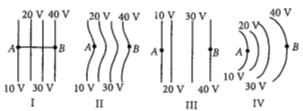
The diagrams below show regions of equipotentials.A positive charge is moved from $A$ to $B$ in each diagram. 
An X-ray tube is operated at $50 kV$. The minimum wavelength produced is.....$Å$
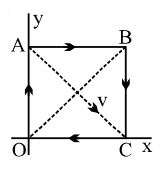
$OABC$ is a current carrying square loop an electron is projected from the centre of loop along its diagonal $AC$ as shown. Unit vector in the direction of initial acceleration will be
A drop of ${10^{ - 6}}\,kg$ water carries ${10^{ - 6}}\,C$ charge. What electric field should be applied to balance its weight (assume $g = 10\,m/{s^2}$)