Question
The drift current in a reverse-biased p-n junction increases in magnitude if the temperatu,re of the junction is increased. Explain this on the basis of creation of hole-electron pairs.

Answer

When the temperature of a reverse-biassed p‒n junction is increased, the breaking of bonds takes place because of the increase in the thermal energy of the charge carriers. Drift current is due to the flow of the minority carriers across the junction. So, when a p‒n junction is reverse biassed, the applied voltage supports the flow of minority charge carriers across the junction. Thus, the drift current increases with increase in temperature in a reverse biassed p‒n junction.

Need a full question paper?

Generate a complete, print-ready paper with questions like this in minutes — across 16+ boards, with answer keys.
Start Generating Free

Similar questions

A point charge of 2.0 μC is at the centre of a cubic Gaussian surface 9.0 cm on edge. What is the net electric flux through the surface?
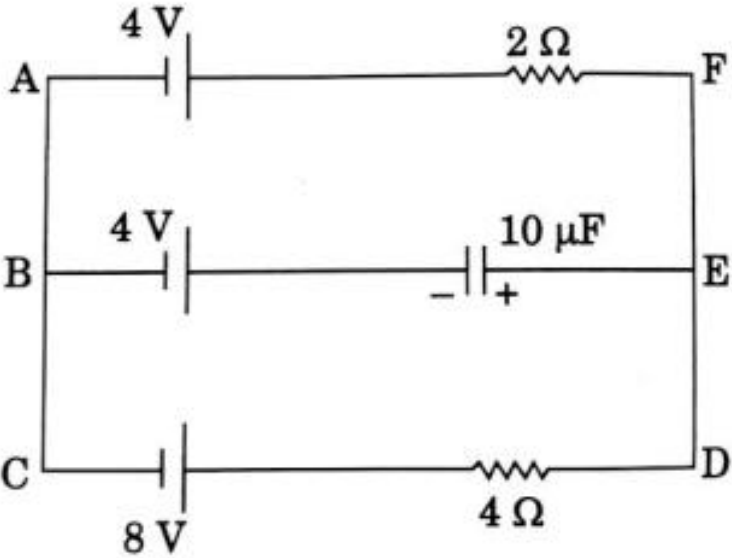
In the given circuit, with steady current, calculate the potential drop across the capacitor and the charge stored in it.

If both the number of protons and number of neutrons are conserved in each nuclear reaction, in what way is mass converted into energy (or vice-versa) in a nuclear reaction?
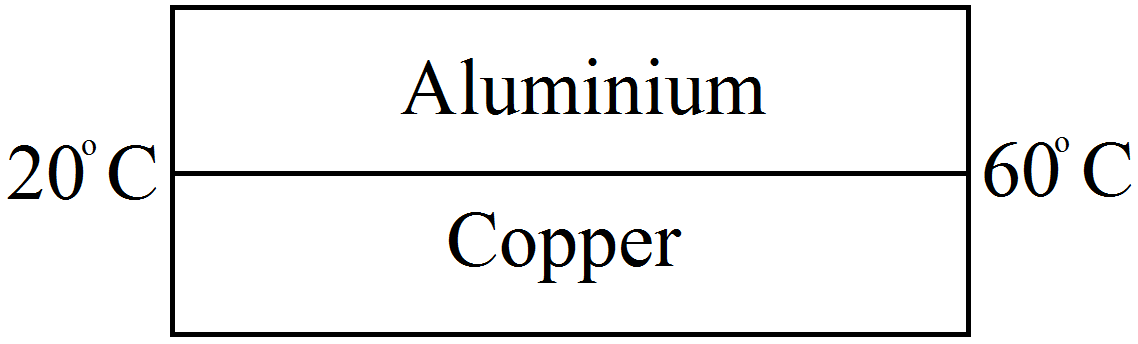
An aluminium rod and a copper rod of equal length 1.0m and cross-sectional area 1cm2 are welded together as shown in figure. One end is kept at a temperature of 20°C and the other at 60°C. Calculate the amount of heat taken out per second from the hot end. Thermal conductivity of aluminium = 200Wm-1°C-1 and of copper = 390Wm-1°C-1.

Two capacitors of capacitances $4.0\mu\text{F}$ and $6.0\mu\text{F}$ are connected in series with a battery of 20V. Find the energy supplied by the battery.
A light ray falling at an angle of 45° with the surface of a clean slab of ice of thickness 1m is refracted into it at an angle of 30°. Calculate the time taken by the light rays, to cross the slab. Speed of light in vacuum = 3 × 10⁸m/s
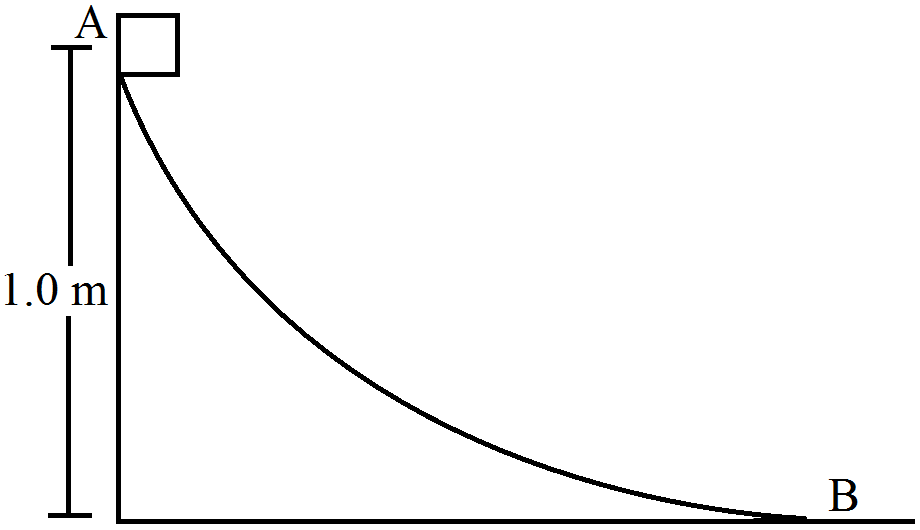
A block weighing 10N travels down a smooth curved track AB joined to a rough horizontal surface (figure). The rough surface has a friction coefficient of 0.20 with the block. If the block starts slipping on the track from a point 1.0m above the horizontal surface, how far will it move on the rough surface?

What is amplitude modulation ? Draw the simple block diagram of a modulator to get amplitude modulated wave.
(I) Draw the energy band diagram for P-type semiconductor at (i) T=0K and (ii) room temperature.
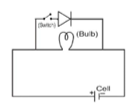
(II) In the given diagram considering an ideal diode, in which condition will the bulb glow
(a) when the switch is open
(b) when the switch is closed
Justify your answer.

Image
A charged particle having a charge of -2.0 × 10⁻⁶C is placed close to a nonconducting plate having a surface charge density 4.0 × 10⁻⁵Cm-2. Find the force of attraction between the particle and the plate.