MCQ
The drift velocity does not depend upon
  • A
    Cross-section of the wire
  • Length of the wire
  • C
    Number of free electrons
  • D
    Magnitude of the current

Answer

Correct option: B.
Length of the wire
(b)

Need a full question paper?

Generate a complete, print-ready paper with questions like this in minutes — across 16+ boards, with answer keys.
Start Generating Free

Similar questions

The average e.m.f. induced in a coil in which the current changes from $2$ ampere to $4$ ampere in $0.05$ second is $8$ volt. What is the self inductance of the coil ?
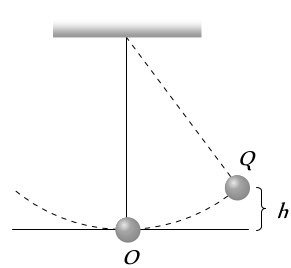
The bob of a simple pendulum is displaced from its equilibrium position $O$ to a position $Q$ which is at height $h$ above $O$ and the bob is then released. Assuming the mass of the bob to be $m$ and time period of oscillations to be $2.0 sec$, the tension in the string when the bob passes through $O$ is
The $6563 \mathring A$ line emitted by hydrogen atom in a star is found to be red shifted by $5 \mathring A$. The speed with which the star is receding from the earth is
A particle falls from a height $h$ upon a fixed horizontal plane and rebounds. If $e$ is the coefficient of restitution, the total distance travelled before rebounding has stopped is
When an ideal gas $(\gamma=5 / 3)$ is heated under constant pressure, then what percentage of given heat energy will be utilised in doing external work
A sphere of radius $r$ is kept on a concave mirror of radius of curvature $R$. The arrangement is kept on a horizontal table (the surface of concave mirror is frictionless and sliding not rolling). If the sphere is displaced from its equilibrium position and left, then it executes S.H.M. The period of oscillation will be
A thin circular wire carrying a current $I$ has a magnetic moment $M$. The shape of the wire is changed to a square and it carries the same current. It will have a magnetic moment
A metal surface of work function $1.07 \ \mathrm{eV}$ is irradiated with light of wavelength $332 \mathrm{~nm}$. The retarding potential required to stop the escape of photo-electrons is
Tube $A$ has both ends open while tube $B$ has one end closed, otherwise they are identical. The ratio of fundamental frequency of tube $A$ and $B$ is
The composition of two simple harmonic motions of equal periods at right angle to each other and with a phase difference of $\pi$ results in the displacement of the particle along