MCQ
The dual nature of light is exhibited by
  • A
    Photoelectric effect
  • B
    Refraction and interference
  • C
    Diffraction and reflection
  • Diffraction and photoelectric effect

Answer

Correct option: D.
Diffraction and photoelectric effect
Diffraction shows the wave nature of light and photoelectric effect shows particle nature of light.

Need a full question paper?

Generate a complete, print-ready paper with questions like this in minutes — across 16+ boards, with answer keys.
Start Generating Free

Similar questions

A moving coil galvanometer allows a full scale current of $10^{-4}\, A$. A series resistance of $2\, M\,\Omega $ is required to convert the above galvanometer into a voltmeter of range $0 -5\, V$. Therefore the value of shunt resistance required to convert the above galvanometer into a ammeter of range $0-10\, mA$ is....$\Omega $
If a cylinder containing a gas at high pressure explodes, the gas undergoes
The magnetic flux through a circuit of resistance $R$ changes by an amount $\Delta \phi$ in time $\Delta t$, Then the total quantity of electric charge $Q$, which passing during this time through any point of the circuit is given by
The frequency of an alternating voltage is $50 cycles / sec$ and its amplitude is $120 V$. Then the r.m.s. value of voltage is
The unit of the coefficient of viscosity in S.l. system is
The amplitude of a particle executing S.H.M. with frequency of 60 $Hz$ is $0.01 m$. The maximum value of the acceleration of the particle is
If a magnet of pole strength $m$ is divided into four parts such that the length and width of each part is half that of initial one, then the pole strength of each part will be
The resistance of a galvanometer is $50\, ohms$ and the current required to give full scale deflection is $100\,\mu A$. In order to convert it into an ammeter, reading upto $10\,A$, it is necessary to put a resistance of
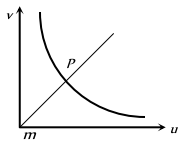
The graph shows variation of $v$ with change in $u$ for a mirror. Points plotted above the point $P$ on the curve are for values of $v$
Image
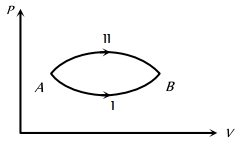
A system goes from $A$ to $B$ via two processes 1 and 11 as shown in figure. If $\Delta U_1$ and $\Delta U_2$ are the changes in internal energies in the processes 1 and 11 respectively, then
Image