Question
The earth’s surface has a negative surface charge density of $10^{-9} Cm^{-2}.$ The potential difference of $400 kV$ between the top of the atmosphere and the surface results $($due to the low conductivity of the lower atmosphere$)$ in a current of only $1800 A$ over the entire globe. If there were no mechanism of sustaining atmospheric electric field, how much time $($roughly$)$ would be required to neutralise the earth’s surface? $($This never happens in practice because there is a mechanism to replenish electric charges, namely the continual thunderstorms and lightning in different parts of the globe$). ($Radius of earth $= 6.37 \times 10^6 m.)$
Answer

Surface charge density of the earth, $\sigma=10^{-9}\ \text{C m}^{-2}$
Current over the entire globe, $\text{I}=1800\ \text{A}$
Radius of the earth, $\text{r}=6.37\times10^6\ \text{m}$
Surface area of the earth,
$\text{A}=4\pi\text{r}^2$
$=4\pi\times(6.37\times10^6)^2$
$=5.09\times10^{14}\ \text{m}^2$
Charge on the earth surface,
$\text{q}=\sigma\times\text{A}$
$=10^{-9}\times5.09\times10^{14}$
$=5.09\times10^{5}\ \text{C}$
Time taken to neutralize the earth's surface $= t$
Current, $\text{I}=\frac{\text{q}}{\text{t}}$
$\text{t}=\frac{\text{q}}{\text{I}}$
$=\frac{5.09\times10^5}{1800}=282.77\text{s}$
Therefore, the time taken to neutralize the earth's surface is $282.77s.$

Need a full question paper?

Generate a complete, print-ready paper with questions like this in minutes — across 16+ boards, with answer keys.

Start Generating Free

Similar questions

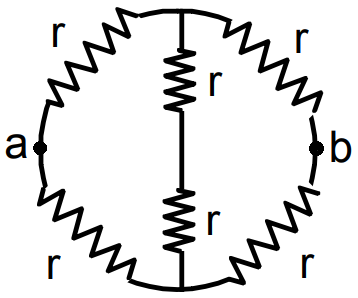
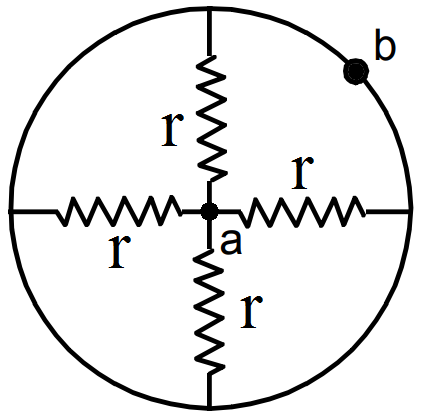
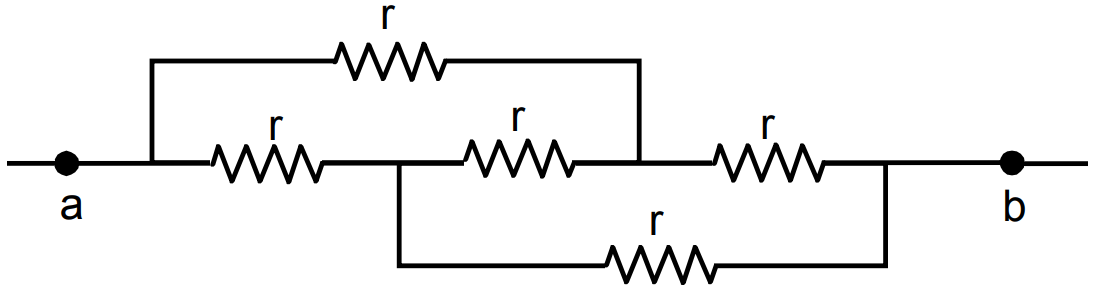
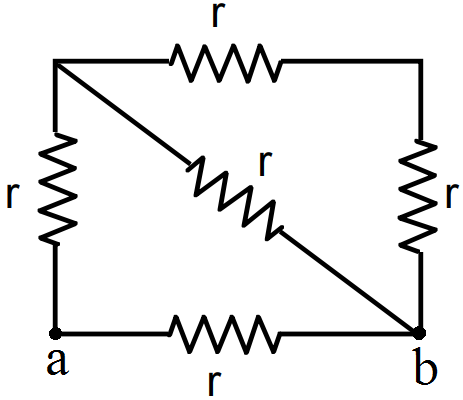
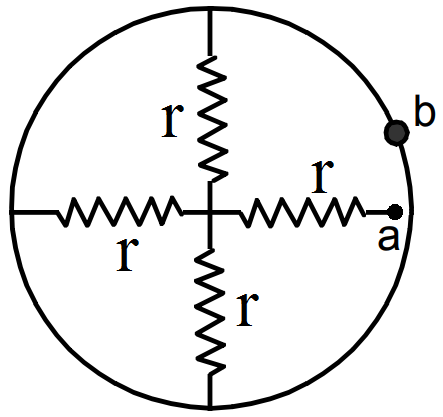
Find the equivalent resistances of the networks shown in the figure. between the points a and b.
  1.  
  1.  
  1.  
  1.  
  1.  
A pendulum having a bob of mass $m$ is hanging in a ship sailing along the equator from east to west. When the ship is stationary with respect to water the tension in the string is $T_0.$
  1. Find the speed of the ship due to rotation of the earth about its axis.
  2. Find the difference between $T_0$ and the earth's attraction on the bob.
  3. If the ship sails at speed $v,$ what is the tension in the string? Angular speed of earth's rotation is $\omega$ and radius of the earth is $R.$
Calculate the minimum and maximum wavelength of hydrogen spectrum emitted in the Balmer series. $(R_{H}=1.1\times10^{7}m^{-1})$
Two moving coil meters, $M_1$ and $M_2$ have the following particulars:
$R_1 = 10 \Omega, N_1 = 30,$
$A_1 = 3.6 \times 10^{–3} m^2, B_1 = 0.25 T$
$R_2 = 14 \Omega, N_2 = 42,$
$A_2 = 1.8 \times 10^{–3} m^2, B_2 = 0.50 T$
$($The spring constants are identical for the two meters$).$
Determine the ratio of $(a)$ current sensitivity and $(b)$ voltage sensitivity of $M_2$ and $M_1.$
A resistor of $200 \Omega$ and a capacitor of $15.0 \mu F$ are connected in series to a $220 V , 50 Hz$ ac source.$ (a)$ Calculate the current in the circuit; $(b) $ Calculate the voltage $(rms)$ across the resistor and the capacitor. Is the algebraic sum of these voltages more than the source voltage? If yes, resolve the paradox.
A monkey of mass $15\ kg$ is climbing on a rope with one end fixed to the ceiling. If it wishes to go up with an acceleration of $1m/s^2,$ how much force should it apply to the rope? If the rope is $5\ m$ long and the monkey starts from rest, how much time will it take to reach the ceiling?
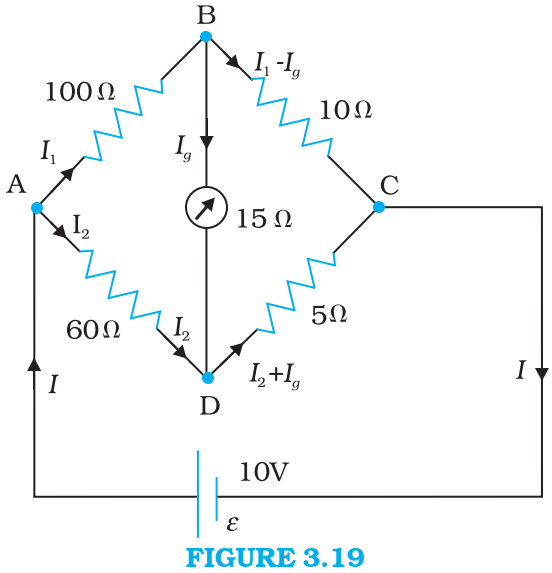
The four arms of a Wheatstone bridge $($Fig. $3.19)$ have the following resistances:
$AB =100 \Omega, BC =10 \Omega, CD =5 \Omega \text {, and } DA =60 \Omega \text {. }$
Image
A galvanometer of $15 \Omega$ resistance is connected across $BD$. Calculate the current through the galvanometer when a potential difference of $10 V$ is maintained across $AC$.
Suppose that the particle in Exercise in $1.33$ is an electron projected with velocity $v_x= 2.0 \times 10^6 m s^{–1}.$ If $E$ between the plates separated by $0.5 \ cm$ is $9.1 \times 10^2N/C,$ where will the electron strike the upper plate? $(|e|=1.6 \times 10^{–19}C, m_e = 9.1 \times 10^{–31} \ kg.)$
Draw the energy band diagrams $($at $T >$ 0K$)$ for $n-$type and $p-$type semiconductors. Using diagram, explain why in $n-$type semiconductor the conduction band has most electrons from the donor impurities.
A certain material has refractive indices 1.56, 1.60 and 1.68 for red, yellow and violet light respectively.
  1. Calculate the dispersive power.
  2. Find the angular dispersion produced by a thin prism of angle 6° made of this material.