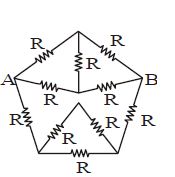
The effective resistance between $A$ and $B$ of the shown network, where resistance of each resistor is $R$ , is
Medium


Download our appand get started for free
Experience the future of education. Simply download our apps or reach out to us for more information. Let's shape the future of learning together!No signup needed.*
Similar Questions
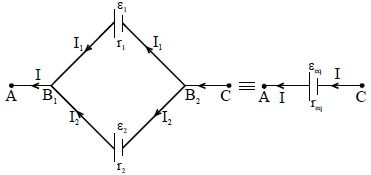
- 1Consider a parallel combination of the cellsshown in the figure.The potential difference in between $B_1$ and $B_2$ isView Solution
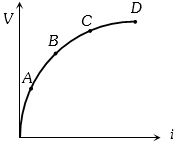
- 2Variation of current passing through a conductor as the voltage applied across its ends as varied is shown in the adjoining diagram. If the resistance $(R)$ is determined at the points $A$, $B$, $C$ and $D$, we will find thatView Solution
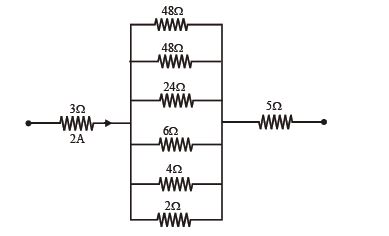
- 3Find potential difference across $24\,\Omega $ ............. $\mathrm{volt}$View Solution
- 4Two resistances equal at $0\,^oC$ with temperature coefficient of resistance $\alpha _1$ and $\alpha _2$ joined in series act as a single resistance in a circuit. The temperature coefficient of their single resistance will beView Solution
- 5At room temperature, copper has free electron density of $8.4 \times {10^{28}}$ per ${m^3}$. The copper conductor has a cross-section of $10^{-6} \,m^2$ and carries a current of $5.4\, A$. The electron drift velocity in copper isView Solution
- 6When a wire of uniform cross-section $a$, length $l$ and resistance $R$ is bent into a complete circle, resistance between any two of diametrically opposite points will beView Solution
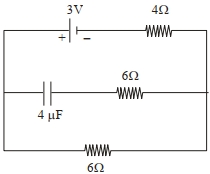
- 7In the network shown below, the charge accumulated in the capacitor in steady state will be ........... $\mu C$View Solution
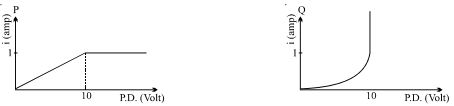
- 8Two current elements $P$ and $Q$ have current voltage characteristics as shown below :View Solution
Which of the graphs given below represents current voltage characteristics when $P$ and $Q$ are in series.
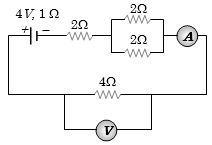
- 9What is the equivalent resistance of the circuit ............. $\Omega$View Solution
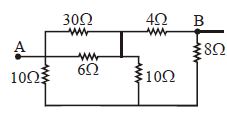
- 10The equivalent resistance across $AB$ would be ............ $\Omega$View Solution