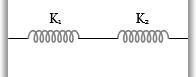
The effective spring constant of two spring system as shown in figure will be
Easy
Download our app for free and get started
(a)When external force is applied, one spring gets extended and another one gets contracted by the same distance hence force due to two springs act in same direction.
i.e. $F = {F_1} + {F_2}$
==> $ - \,kx = - \,{k_1}x - {k_2}x$
$\Rightarrow $$k = {k_1} + {k_2}$

Download our appand get started for free
Experience the future of education. Simply download our apps or reach out to us for more information. Let's shape the future of learning together!No signup needed.*
Similar Questions
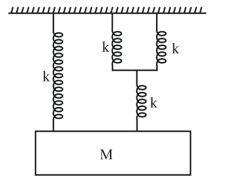
- 1The time period of simple harmonic motion of mass $\mathrm{M}$ in the given figure is $\pi \sqrt{\frac{\alpha M}{5 K}}$, where the value of $\alpha$ is____.View Solution
- 2Due to some force $F_1$ a body oscillates with period $4/5\, sec$ and due to other force $F_2$ oscillates with period $3/5\, sec$. If both forces act simultaneously, the new period will be .... $\sec$View Solution
- 3Two simple harmonic waves having equal amplitudes of $8\,cm$ and equal frequency of $10\,Hz$ are moving along the same direction. The resultant amplitude is also $8\,cm$. The phase difference between the individual waves is $..................$ degree.View Solution
- 4The function $sin^2\,(\omega t)$ representsView Solution
- 5The function $sin^2\,(\omega t)$ representsView Solution
- 6If the length of the simple pendulum is increased by $44\%$, then what is the change in time period of pendulum ..... $\%$View Solution
- 7The displacement of a particle varies according to the relation $x = 3 \sin 100 \, t + 8 \cos ^2 50\,t $. Which of the following is/are correct about this motion .View Solution
- 8A body executing simple harmonic motion has a maximum acceleration equal to $ 24\,metres/se{c^2} $ and maximum velocity equal to $ 16\;metres/sec $. The amplitude of the simple harmonic motion isView Solution
- 9The displacement of a particle executing $S.H.M.$ is given by $x=0.01 \sin 100 \pi(t+0.05)$. The time period is ........ $s$View Solution
- 10A particle doing simple harmonic motion, amplitude $= 4\, cm$, time period $= 12\, sec$. The ratio between time taken by it in going from its mean position to $2 \,cm$ and from $2\, cm$ to extreme position isView Solution