MCQ
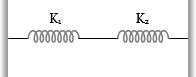
The effective spring constant of two spring system as shown in figure will be
  • ${K_1} + {K_2}$
  • B
    ${K_1}{K_2}/{K_1} + {K_2}$
  • C
    ${K_1} - {K_2}$
  • D
    ${K_1}{K_2}/{K_1} - {K_2}$

Answer

Correct option: A.
${K_1} + {K_2}$
a
(a)When external force is applied, one spring gets extended and another one gets contracted by the same distance hence force due to two springs act in same direction.

i.e. $F = {F_1} + {F_2}$

==> $ - \,kx = - \,{k_1}x - {k_2}x$

$\Rightarrow $$k = {k_1} + {k_2}$

Need a full question paper?

Generate a complete, print-ready paper with questions like this in minutes — across 16+ boards, with answer keys.

Start Generating Free

Similar questions

In Searle's method for finding conductivity of metals, the temperature gradient along the bar
The displacement of a particle is given by $\overrightarrow{\text{r}}=\text{A}\big(\overrightarrow{\text{i}}\cos\omega\text{t}+\overrightarrow{\text{j}}\sin\omega\text{t}\big)$ The motion of the particle is:
A razor-blade floats on the surface of water contained in a glass. When the glass is gently shaken, the razor-blade sinks. Mark the incorrect statement
Two particles of identical mass are moving in circular orbits under a potential given by $V(r)=K r^{-n}$, where $K$ is a constant. If the radii of their orbits are $r_1 \cdot r_2$ and their speeds are $v_1 \cdot v_2$, respectively. Then,
A transverse wave propagating along $X-$axis is represented by
$\text{y (x, t)}=8.0\sin(0.5\pi\text{x}-4\pi\text{t}-\frac{\pi}{4})$
where $x$ is in metre and $t$ is in seconds. The speed of the wave is:
Consider two observers moving with respect to each other at a speed $v$ along a straight line. They observe a block of mass $m$ moving a distance $l$ on a rough surface. The following quantities will be same as observed by the two observers.
A camet (assumed to be in an elliptical orbit around the sun) is at a distance of $0.4 \,AU$ from the sun at the perihelion. If the time period of the camet is $125 \,yr$.the aphelion distance is ........... $AU$ ($AU$ : Astronomical Unit)
Sand is being dropped on a conveyer belt at the rate of $M\, kg/s.$ The force necessary to keep the belt moving with a constant velocity of $v\,m/s$ will be
Select the correct statements for a particle going on a straight line:
Sand is being dropped on a conveyer belt at the rate of $2\,kg$ per second . The force necessary to keep the belt moving with a constant speed of $3\,ms^{-1}$ will be  ........... $N$