MCQ
The Einstein’s photo-electric equation is based upon the conservation of:
- AMass
- BMomentum
- CAngular momentum
- DEnergy
Explanation:
Einsteins photoelectric equations states that
Ek = hν − $\phi$
where, Ek is maximum kinetic energy of emitted photoelectrons
h is plank's constant.
ν is frequency of incident light
$\phi$ is work function of metal.
So, it is clearly based upon energy conservation.
Generate a complete, print-ready paper with questions like this in minutes — across 16+ boards, with answer keys.
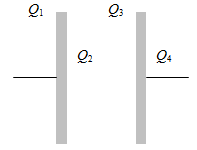
In an isolated parallel plate capacitor of capacitance C, the four surface have charges  and
and  as shown. The potential difference between the plates is
|
(a) |
(b) |
(c) |
(d) |
The light of wavelength 6328 Å is incident on a slit of width 0.2 mm perpendicularly, the angular width of central maxima will be
|
(a) 0.36° |
(b) 0.18 ° |
(c) 0.72° |
(d) 0.09° |
The magnetic field lines due to a bar magnet are correctly shown in
|
(a)
|
(b)
|
(c)
|
(d)
|
A 100 watt bulb working on 200 volt and a 200 watt bulb working on 100 volt have
|
(a) Resistances in the ratio of 4 : 1 |
|
(b) Maximum current ratings in the ratio of 1 : 4 |
|
(c) Resistances in the ratio of 2 : 1 |
|
(d) Maximum current ratings in the ratio of 1 : 2 |
During a negative beta decay
|
(a) An atomic electron is ejected |
|
(b) An electron which is already present within the nucleus is ejected |
|
(c) A neutron in the nucleus decays emitting an electron |
|
(d) A part of the binding energy is converted into electron |


