Question
The electric field associated with a monochromatic beam becomes zero 1.2 × 1015 times per second. Find the maximum kinetic energy of the photoelectrons when this light falls on a metal surface whose work function is 2.0eV.

Answer

 The electric field becomes 01.2 × 1045 times per second.

$\therefore$ Frequency $=\frac{1.2\times10^{15}}{2}=0.6\times10^{15}$

$\text{hv}=\phi_0+\text{kE}$

$\Rightarrow\text{hv}-\phi_0=\text{KE}$

$\Rightarrow\text{KE}=\frac{6.63\times10^{-34}\times0.6\times10^{15}}{1.6\times10^{-19}}-2$

$=0.482\text{ev}=0.48\text{ev.}$

Need a full question paper?

Generate a complete, print-ready paper with questions like this in minutes — across 16+ boards, with answer keys.
Start Generating Free

Similar questions

Light of wavelength 5000 Å falls on a plane reflecting surface. What are the wavelength and frequency of the reflected light? For what angle of incidence is the reflected ray normal to the incident ray?
  1. Define ‘activity’ of a radioactive substance.
  2. Two different radioactive elements with half lives T1 and T2 have N1 and N2 undecayed atoms respectively present at a given instant. Derive an expression for the ratio of their activities at this instant in terms of N1 and N2.
Draw the circuit diagram of a full wave rectifier and explain its working. Also, give the input and output waveforms.
Calculate the number of photons emitted per second by a 10W sodium vapour lamp. Assume that 60% of the consumed energy is converted into light. Wavelength of sodium light = 590nm.
Two narrow slits emitting iight in phase are separated by a distance of 1.0cm. The wavelength of the light is 5.0 × 10⁻⁷m. The interference pattern is observed on a screen placed at a distance of 1.0m.
  1. Find the separation between the consecutive maxima. Can you expect to distinguish between these maxima?
  2. Find the separation between the sources which will give a separation of 1.0mm between the consecutive maxima.
When a block of mass M is suspended by a long wire of length L, the elastic potential energy stored in the wire is $\frac{1}{2}\times$ stress × strain × volume. Show that it is equal to $\frac{1}{2}\text{Mgl}$ where l is the extension. The loss in gravitational potential energy of the Mass-earth sustem is Mgl. does the remaining $\frac{1}{2}\text{Mgl}$ energy go?
The potential difference across a resistor ‘r’ carrying current ‘I’ is Ir.
  1. Now if the potential difference across ‘r’ is measured using a voltmeter of resistance ‘RV’, show that the reading of voltmeter is less than the true value
  2. Find the percentage error in measuring the potential difference by a voltmeter.
  3. At what value of RV, does the voltmeter measures the true potential difference?
A solenoid of length 1.0m, radius 1cm and total turns 1000 wound on it, carries a current of 5A. Calculate the magnitude of the axial magnetic field inside the solenoid. If an electron was to move with a speed of 104ms–1 along the axis of this current carrying solenoid, what would be the force experienced by this electron?
A radioactive isotope is being produced at a constant rate $\frac{\text{dN}}{\text{dt}}=\text{R}$ in an experiment. The isotope has a half-life $\text{t}_{\frac{1}2{}}.$ Show that after a time $\text{t}>>\text{t}_{\frac{1}{2}},$ the number of active nuclei will become constant. Find the value of this constant.
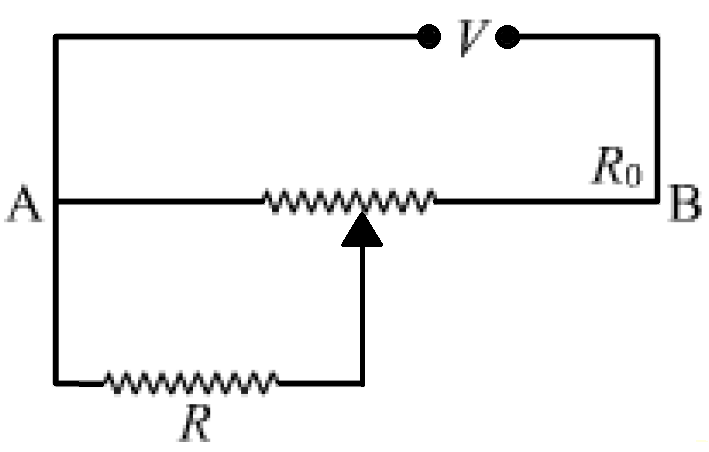
A resistance of R draws current from a potentiometer. The potentiometer wire, AB, has a total resistance of Ro. A voltage V is supplied to the potentiometer. Derive an expression for the voltage across R when the sliding contact is in the middle of potentiometer wire.