MCQ
The electric field inside a hollow conducting sphere:
- AIncreases towards the centre.
- BDecreases towards the centre.
- CIs finite and constant throughout.
- DIs zero.
Explanation:
As there are no charges inside the hollow conducting sphere, as all charges reside on it surface. So, electric field inside the hollow conducting sphere is zero.
Generate a complete, print-ready paper with questions like this in minutes — across 16+ boards, with answer keys.
Total internal reflection is possible when light rays travel
|
(a) Air to water |
(b) Air to glass |
(c) Glass to water |
(d) Water to glass |
In X-ray spectrum wavelength  of line
  depends on atomic number Z as
|
(a) |
(b) |
(c) |
(d) |
In the forward bias arrangement of a PN-junction diode
|
(a) The N-end is connected to the positive terminal of the battery |
|
(b) The P-end is connected to the positive terminal of the battery |
|
(c) The direction of current is from N-end to P-end in the diode |
|
(d) The P-end is connected to the negative terminal of battery |
An X-ray has a wavelength of 0.010 Å. Its momentum is
| (a) 2.126 × 10⁻²³ kg-m/sec | (b) 6.626 × 10⁻²² kg-m/sec |
| (c) 3.456 × 20–25 kg-m/sec | (d) 3.313 × 10⁻²² kg-m/sec |
At the magnetic poles of the earth, a compass needle will be
|
(a) Vertical |
(b) Bent slightly |
|
(c) Horizontal |
(d) Inclined at 45o to the horizontal |
The resistance of a coil is 4.2 Ω at 100 oC and the temperature coefficient of resistance of its material is 0.004/o C. Its resistance at 0o C is
| (a) 6.5 Ω | (b) 5 Ω |
(c) 3 Ω |
(d) 4 Ω |
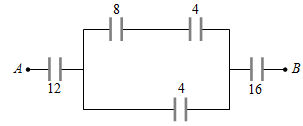
What is the equivalent capacitance between A and B in the given figure (all are in farad)
|
(a) |
(b) |
(c) |
(d) |


