MCQ
The electric field near a conducting surface having a uniform surface charge density σ is given by
  • A
    $\frac{\sigma}{\varepsilon_0}$ and is parallel to the surface
  • B
    $\frac{2\sigma}{\varepsilon_0}$ and is parallel to the surface
  • $\frac{\sigma}{\varepsilon_0}$ and is normal to the surface
  • D
    $\frac{2\sigma}{\varepsilon_0}$ and is normal to the surface
Answer

Correct option: C.
$\frac{\sigma}{\varepsilon_0}$ and is normal to the surface
(c) $\frac{\sigma}{\varepsilon_0}$ and is normal to the surface

Need a full question paper?

Generate a complete, print-ready paper with questions like this in minutes — across 16+ boards, with answer keys.

Start Generating Free

Similar questions

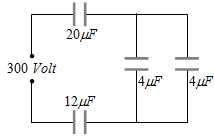
In the adjoining figure, four capacitors are shown with their respective capacities and the P.D. applied. The charge and the P.D. across the 4μF capacitor will be
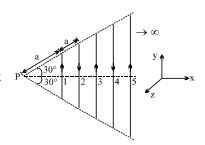
Infinite number of straight wires each carrying current $I$ are equally placed as shown in the figure. Adjacent wires have current in opposite direction. Net magnetic field at point $P$ is
A coil is placed in a time varying magnetic field. If the number of turns in the coil were to be halved and the radius of wire doubled, the electrical power dissipated due to the current induced in the coil would be:

(Assume the coil to be short circuited.)

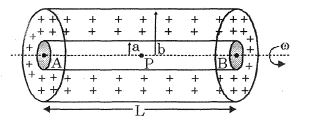
A thick uniformly charged hollow cylinder of inner radius $a$ and outer radius $b$ rotates with constant angular speed $\omega $ about its axis $APB$, charge density$  = \rho $

Given that $L >>> a$ $L >>> b$ and $P$ is mid point of $AB$. Choose the incorrect option

The radioactive decay of uranium into thorium is expressed by the equation $_{92}^{238}U \to _{90}^{234}Th + X,$ where $'X'$ is
The kinetic energy of emitted electron is $E$ when the light incident on the metal has wavelength $\lambda$. To double the kinetic energy, the incident light must have wavelength.
A hollow metal sphere of radius 5 cm is charged so that the potential on its surface is 10 V. The potential at the centre of the sphere is
The fringe width in Young’s double slit experiment increases when
A series LCR circuit with inductance $10\,H$, capacitance $10\,\mu F$, resistance $50\,\Omega$ is connected to an ac source of voltage, $V=200 \sin (100 t)$ volt. If the resonant frequency of the LCR circuit is $\nu_{0}$ and the frequency of the ac source is $v$, then:
A parallel-plate capacitor is connected to a resistanceless circuit with a battery until the capacitor is fully charged. The battery is then disconnected from the circuit and the plates of the capacitor are moved to half of their original separation using insulated gloves. Let $V_{new}$ be the potential difference across the capacitor plates when the plates have moved. Let $V_{old}$ be the potential difference across the capacitor plates when they were connected to the battery $\frac{V_{new}}{V_{old}}=$......