MCQ
The Electric flux through the surface:
- AIn Fig. 1.3 (iv) is the largest.
- BIn Fig. 1.3 (iii) is the least.
- CIn Fig. 1.3 (ii) is same as Fig. 1.3 (iii) but is smaller than Fig. 1.3 (iv)
- DIs the same for all the figures.
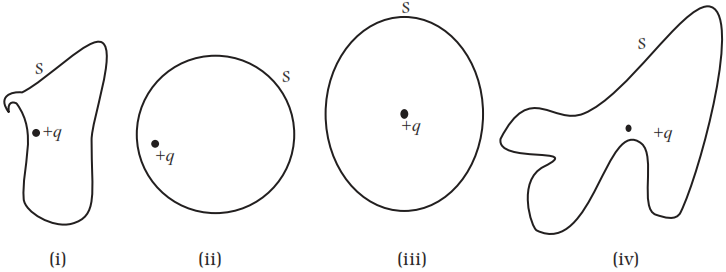
Key concept: According to Gauss' law of electrostatics, the total electric flux out of a closed surface is equal to the charge enclosed divided by the permittivity,
$\text{i.e.,}\phi=\frac{\text{Q}_\text{enclosed}}{\in_0}$
Thus, electric flux through a surface doesn't depend on the shape, size or area of a surface but it depends on the amount of charge enclosed by the surface.
In given figures the charge enclosed are same that means the electric flux through all the surfaces should be the same. Hence option (d) is correct.
Generate a complete, print-ready paper with questions like this in minutes — across 16+ boards, with answer keys.
Radiations of intensity 0.5 are striking a metal plate. The pressure on the plate is
|
(a) 0.166 |
(b) 0.332 |
|
(c) 0.111 |
(d) 0.083 |
The resistance of a germanium junction diode whose V - I is shown in figure is 

| (a) 5 kW | (b) 0.2 kW | (c) 2.3 kW |
(d) 
|
The field due to a long straight wire carrying a current I is proportional to
|
(a) I |
(b) |
(c) |
(d) 1/I |
In Rutherford scattering experiment, what will be the correct angle for α scattering for an impact parameter b = 0
|
(a) 90° |
(b) 270° |
(c) 0° |
(d) 180° |


