Question
The electrochemical cell shown below is concentration cell.

M|M2+ (saturated solution of a sparingly soluble salt, MX2) || M2+ (0.001 mol dm-3) |M The emfof the cell depends on the difference in concentrations of M2+ ions at the two electrodes. The emf of the cell at 298 K is 0.059V.

The following questions are multiple choice questions. Choose the most appropriate answer:

  1. The solubility product (Ksp' mol3 dm-9) of MX2 at 298 K based on the information available for the given concentration cell is $(\text{take }2.303 \times \text{R}\times \frac{298}{\text{F}} = 0.059)$
  1. 2 × 10-15
  2. 4 × 10-15
  3. 3 × 10-12
  4. 1 × 10-12
  1. The value of $\triangle\text{G}$ (in kJ mol-1) for the given cell is (take 1 F = 96500 C mol-1)

  1. 3.7
  2. -3.7
  3. 10.5
  4. -11.4
  1. The equilibrium constant for the foUowing reaction is:

$\text{Fe}^{2+}+\text{Ce}^{4+}\rightleftharpoons\text{Ce}^{3+}+\text{Fe}^{3+}$

(Given, $\text{E}^\circ_\frac{\text{Ce}^{4+}}{\text{Ce}^{3+}}=1.44\text{V}$ and $\text{E}^\circ_\frac{\text{Fe}^{3+}}{\text{Fe}^{2+}}=0.68\text{V}$)

  1. 7.6 × 10¹²
  2. 6.5 × 1010
  3. 5.2 × 109
  4. 3.4 × 1012
  1. The solubility product of a saturated solution of Ag2CrO4 in water at 298 K if the emf of the cell

Ag|Ag+ (satd. Ag2CrO4 soln) || Ag+ (0.1 M) | Ag

is 0.164V at 298 K, is:

  1. 3.359 × 10⁻¹² mol3 L-3
  2. 2.287 × 10⁻¹² mol3 L-3
  3. 1.158 × 10⁻¹² mol3 L-3
  4. 4.135 × 10⁻¹² mol3 L-3
  1. To calculate the emf of the cell, which of the foUowing options is correct?
  1. emf = Ecathode - Eanode
  2. emf = Eanode - Ecathode
  3. emf = Eanode + Ecathode
  4. None of these.

Answer

  1. (b) 4 × 10-15

Explanation:

$0.059=\frac{+0.059}{2}\log\frac{0.001}{[\text{M}^{2+}]}$

$\log\frac{0.001}{[\text{M}^{2+}]}=2$ or $[\text{M}^{2+}]=10^{-5}$

Let solubility of sah be S mol/ litre.

Thus, $\text{MX}_2\xrightarrow{\ \ \ \ }\text{M}^{2+}+2\text{X}^-\\\ \ \text{S}\ \ \ \ \ \ \ \ \ \ \ \ \text{S}\ \ \ \ \ \ \ \ \ \ 2\text{S}$

$\therefore\text{K}_\text{sp}=4\text{S}^3=4\times(10^{-5})^3=4\times10^{-15}$

  1. (d) -11.4

Explanation:

$\triangle\text{G}=\text{nFE}=-2\times96500\times0.059$

= -11387 J mol-1 = -11.4 kJ mol-1

  1. (a) 7.6 × 10¹²

Explanation:

$\text{E}^\circ_\text{cell}=\frac{0.059}{1}\log\text{K}_\text{C}$

$\text{E}^\circ_\text{cell}=\text{E}^\circ_\frac{{\text{Fe}^{2+}}}{{\text{Fe}^{3+}}}+\text{E}^\circ_\frac{\text{Ce}^{4+}}{\text{Ce}^{3+}}$

$= -0.68 + 1.44 = 0.76 \text{V}$

$\log_{10}\text{K}_\text{C}=\frac{0.76}{0.059}=12.88$

$\text{K}_\text{C}=7.6\times10^{12}$

  1. (b) 2.287 × 10⁻¹² mol3 L-3

Explanation:

$\text{E}_\text{cell}=\frac{0.059}{1}\log\frac{[\text{Ag}^+]_\text{RHS}}{[\text{Ag}^+]_\text{LHS}}$

$0.164=\frac{0.059}{1}\log\frac{0.1}{[\text{Ag}^+]_\text{LHS}}$

$[\text{Ag}^+]_\text{LHS}=1.66\times10^{-4}\text{M}$

So, $[\text{CrO}^{2-}_4]=\frac{1.66\times10^{-4}}{2}$

$\text{K}_\text{Sp}(\text{Ag}_2\text{CrO}_4)=[\text{Ag}^+]^2[\text{CrO}_4^{2-}]$

$= (1.66\times10^{-4} )^2\Big(\frac{1.66\times10^{-4}}{2}\Big)$

$=2.287\times10^{-12} \text{mol}^{3} \text{L}^{-3}$

  1. (a) emf = Ecathode - Eanode

Need a full question paper?

Generate a complete, print-ready paper with questions like this in minutes — across 16+ boards, with answer keys.

Start Generating Free

Similar questions

Write detailed note on: Starch
Read the passage given below and answer the following questions:

If some solute is added to a solvent, the boiling point of solution increases. This is known as elevation in baiting point.

$\Delta\text{T}_\text{b}=\text{K}_\text{b}\text{m}$ where, Kb = Molal elevation constant,

$\Delta\text{T}_\text{b}\propto\text{m}$

Hence, it is a colligative property,

Also, $\text{K}_\text{b}=\frac{\text{MRT}^2_\text{b}}{\Delta\text{Vap}\text{H}\times1000}$

where, M = Molar mass of solvent,

$\Delta\text{vap}$ H = Enthalpy of vaporisation,

Molar mass can also be calculated using elevation in boiling point.

$\text{M}_\text{B}=\frac{\text{K}_\text{B}\times\text{W}_\text{B}\times1000}{\Delta\text{T}_\text{b}\times\text{W}_\text{A}}$

A statement of assertion followed by a statement of reason is given. Choose the correct answer out of the following choices.

  1. Assertion and reason both are correct statements and reason is correct explanation for assertion.
  2. Assertion and reason both are correct statements but reason is not correct explanation for assertion.
  3. Assertion is correct statement but reason is wrong statement.
  4. Assertion is wrong statement but reason is correct statement.
  1. Assertion: In a pressure cooker, the water is brought to boil. The cooker is then removed from the stove. Now on removing the lid of pressure cooker, the water starts boiling again.

Reason: The impurities in water bring down its boiling point.

  1. Assertion: On dissolving 3.24g of sulphur in 40g of benzene, boiling point of solution get higher than that of benzene by 0.081K, then the formula of sulphur is S8. (Kb for benzene = 2.53K kg mol-1)

Reason: Molecular mass of sulphur comes out to be 253.

  1. Assertion: When sugar is added to water, boiling point of water increases.

Reason: When a non-volatile solute is added to a solvent, elevation in boiling point is observed.

  1. Assertion: Cooking time in pressure cookers is reduced.

Reason: Boiling point inside the pressure cooker in raised.

  1. Assertion: Elevation in boiling point of two isotonic solutions is same.

Reason: Boiling point depends upon the concentration of the solute.

Explain the structure of nucleic acid compounds.
Read the passage given below and answer the following questions:
At 298 K, the vapour pressure of pure benzene, C6, H6 is 0.256 bar and the vapour pressure of pure toluene C6 H5 CH3 is 0.0925 bar. Two mixtures were prepared as follows:
  1. 7.8g of C6 H6 + 9.2g of toluene
  2. 3.9g of C6 H6 + 13.8g of toluene
The following questions are multiple choice questions. Choose the most appropriate answer:
  1. The total vapour pressure (bar) of solution I is.
  1. 0.128
  2. 0.174
  3. 0.198
  4. 0.258
  1. Which of the given solutions have higher vapour pressure?
  1. I
  2. II
  3. Both have equal vapour pressure
  4. Cannot be predicted
  1. Mole fraction of benzene in vapour phase in solution I is.
  1. 0.128
  2. 0.174
  3. 0.734
  4. 0.266
  1. Which of the following statements is/are correct?
  1. Mole fraction of toluene in vapour phase is more in solution I.
  2. Mole fraction of toluene in vapour phase is less in solution I.
  3. Mole fraction of benzene in vapour phase is less in solution I.
  1. Only II
  2. Only I
  3. I and III
  4. II and III
  1. Solution I is an example of a/an.
  1. Ideal solution.
  2. Non-ideal solution with positive deviation.
  3. Non-ideal solution with negative deviation.
  4. Can't be predicted.

Read the passage given below and answer the following questions:

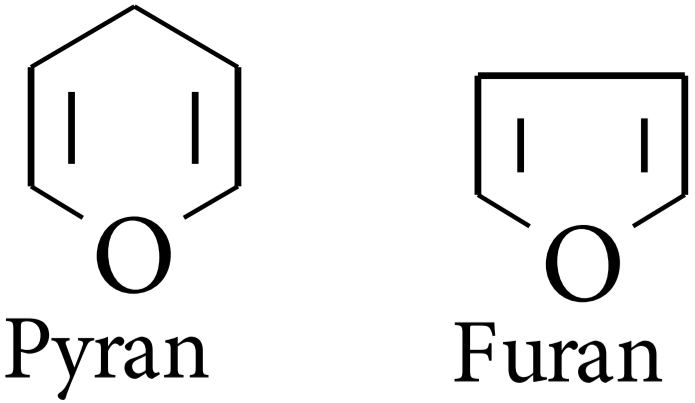
Pentose and hexose undergo intramolecular hemiacetal or hemiketal formation due to combination of the –OH group with the carbonyl group. The actual structure is either of five or six membered ring containing an oxygen atom. In the free state all pentoses and hexoses exist in pyranose form (resembling pyran). However,inthe combined state some of them exist as five membered cyclic structures, called furanose (resembling furan).

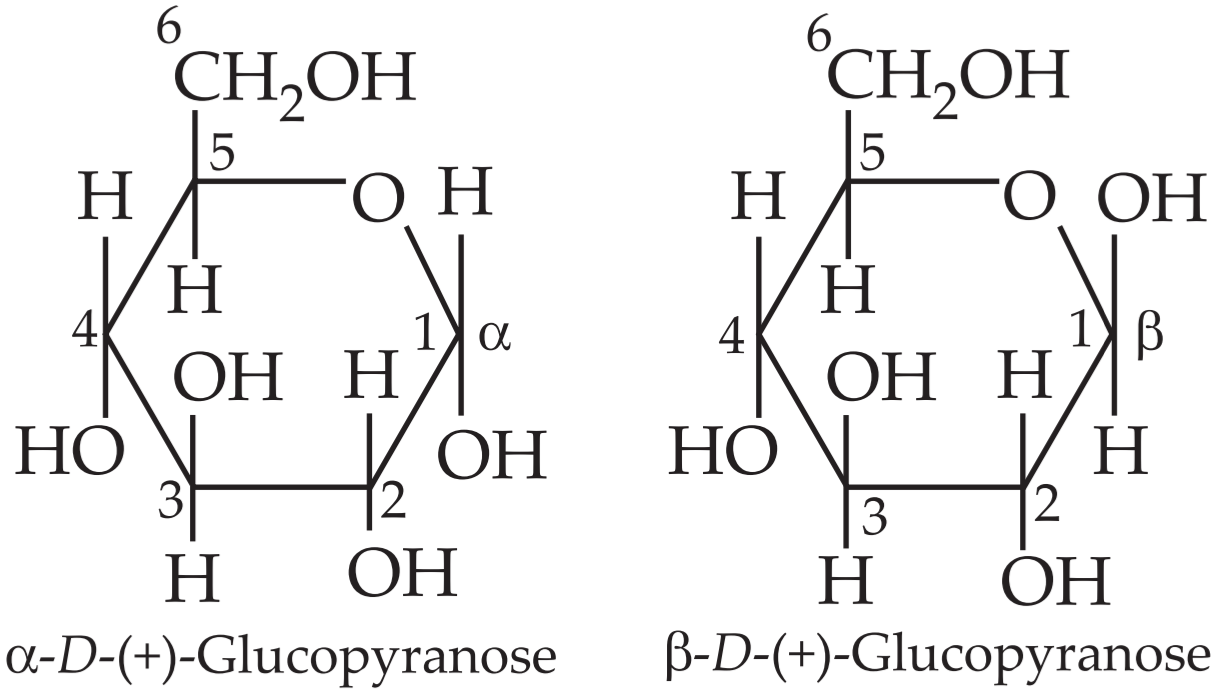
The cyclic structure of glucose is represented by Haworth structure:

$\alpha$ and $\beta$ D-glucose have different configuration at anomeric (C-1) carbon atom, hence are called anomers and the C-1 carbon atom is called anomeric carbon (glycosidic carbon).

The six membered cyclic structure of glucose is called pyranose structure.

The following questionsare multiple choice questions. Choose the most appropriate answer:

  1. $\alpha$ D(+)-glucose and $\beta$ D(+)glucose are:
  1. Enantiomers.
  2. Conformers.
  3. Epimers.
  4. Anomers.
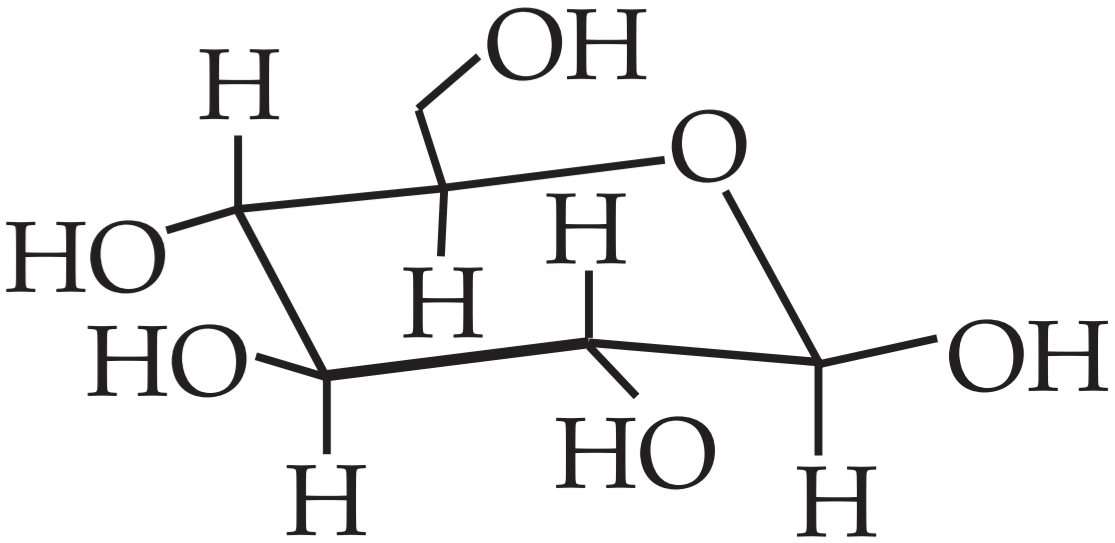
  1. The following carbohydrate is:


  1. A ketohexose.
  2. An aldohexose.
  3. An n-furanose.
  4. An $\alpha$-pyranose.
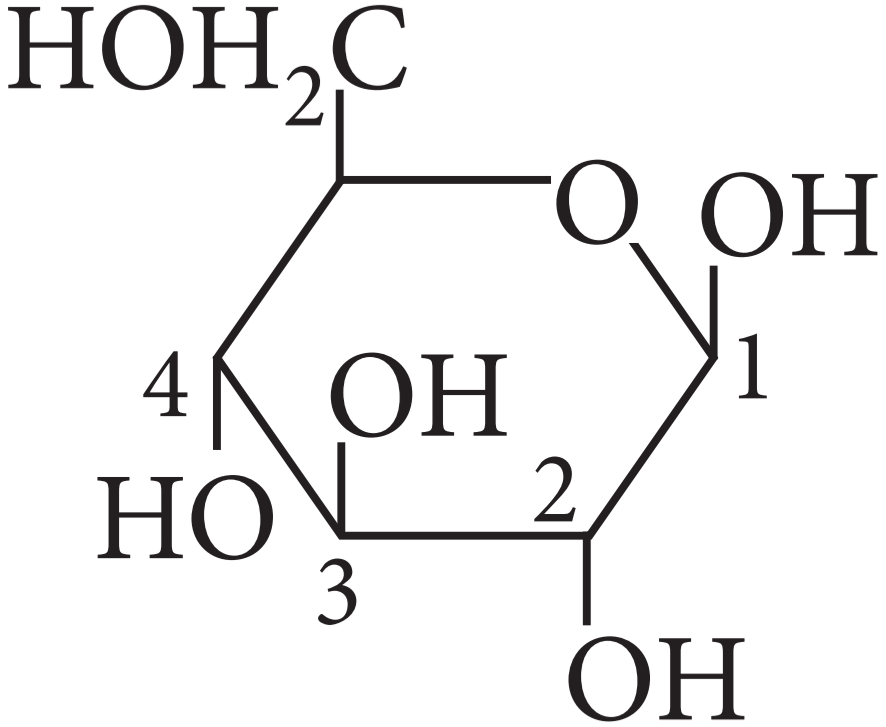
  1. In the following structure, anomeric carbon is:

  1. C-1
  2. C-2
  3. C-3
  4. C-4
  1. The term anomers of glucose refers to:
  1. Isomers of glucose that differ in configurations at carbons one and four (C-1 and C-4).
  2. A mixture of (D)-glucose and (L)-glucose.
  3. Enantiomers of glucose.
  4. Isomers of glucose that differ in configuration at carbon one (C-1).
  1. What percentage of $\beta$-D-(+) glucopyranose is found at equilibrium in the aqueous solution?
  1. 50%
  2. $\approx100%$

  3. 36%
  4. 64%
For a first order reaction, A → Products, $\text{k}=\frac{2.303}{\text{t}}\log\frac{\text{a}}{\text{a}-\text{x}},$ where a is the initial concentration of A and (a - x) is the concentration of A after time t. k is rate constant. Its value is constant at constant temperature for a reaction. The time in which half of the reactant is consumed is called half-life period. Half-life period of a first order reaction is constant. Its value is independent of initial concentration or any other external conditions.

In these questions (Q. No. i-iv), a statement of assertion followed by a statement ofreason is given. Choose the correct answer out of the following choices.

  1. Assertion and reason both are correct statements and reason is correct explanation for assertion.
  2. Assertion and reason both are correct statements but reason is not correct explanation for assertion.
  3. Assertion is correct statement but reason is wrong statement.
  4. Assertion is wrong statement but reason is correct statement.
  1. Assertion: Rate of reaction doubles when concentration of reactant is doubled if it is a first order reaction.

Reason: Rate constant also doubles.

  1. Assertion: For the first order reaction, half-life period is expressed as $\text{t}_\frac{1}{2}=\frac{2.303}{\text{k}}\log2.$

Reason: The half-life time of a first order reaction is not always constant and it depends upon the initial concentration of reactants.

  1. Reason: The half-life time of a first order reaction is not always constant and it depends upon the initial concentration of reactants.

Reason: Acid only acts as a catalyst whereas alkali acts as one of the reactants.

  1. Assertion: For a first order reaction, the concentration of the reactant decreases exponentially with time.

Reason: Rate of reaction at any time depends upon the concentration of the reactant at that time.

  1. Assertion: Half-life period for a first order reaction is independent of initial concentration of the reactant.

Reason: For a first order reaction, $\text{t}_\frac{1}{2}=\frac{0.693}{\text{k}},$ where k is rate constant.

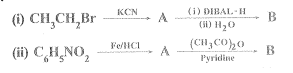
Give the structures of A and B in the following reactions
Image
The following reaction, $\text{A}_{(\text{g})}\xrightarrow{\ \ \triangle\ \ \ }\text{P}_{(\text{g})}+\text{Q}_{(\text{g})}+\text{R}_{(\text{g})},$ follows first order kinetics. The half-life period of this reaction is 69.3s at 500ºC. The gas A is enclosed in a container at 500ºC and at a pressure of 0.4 atm.
The following questions are multiple choice questions. Choose the most appropriate answer:
  1. The rate constant for the reaction is:
  1. 0.4s-1
  2. 0.02s-1
  3. 0.01s-1
  4. 0.3s-1
  1. The pressure of the gas A after 230 s will be:
  1. 0.04 atm
  2. 0.36 atm
  3. 0.4 atm
  4. 0.036 atm
  1. The total pressure of the system after 230 swill be:
  1. 2.15 atm
  2. 1.12 atm
  3. 0.4 atm
  4. 3.08 atm
  1. The plot ofln[A] vs twill be:
  1. Linear with slope = k
  2. Linear with intercept = In[A]0
  3. Linear with slope = In[A]0
  4. Linear with intercept = [A]0
  1. Which of the following is not an example of first order reaction?
  1. $\text{C}_2\text{H}_{4(\text{g})}+\text{H}_{2(\text{g})}\rightarrow\text{C}_2\text{H}_{6(\text{g})}$
  2. $2\text{N}_2\text{O}_{5(\text{g})}\rightarrow4\text{NO}_{2(\text{g})}+\text{O}_{2(\text{g})}$
  3. $2\text{N}\text{H}_{3(\text{g})}\xrightarrow[\triangle]{\text{pt}}\text{N}_{2(\text{g})}+3\text{H}_{2(\text{g})}$
  4. $2\text{N}_2\text{O}_{(\text{g})}\xrightarrow{\ \ \triangle\ \ }2\text{N}_{2(\text{g})}+\text{O}_{2(\text{g})}$

Read the passage given below and answer the following questions:

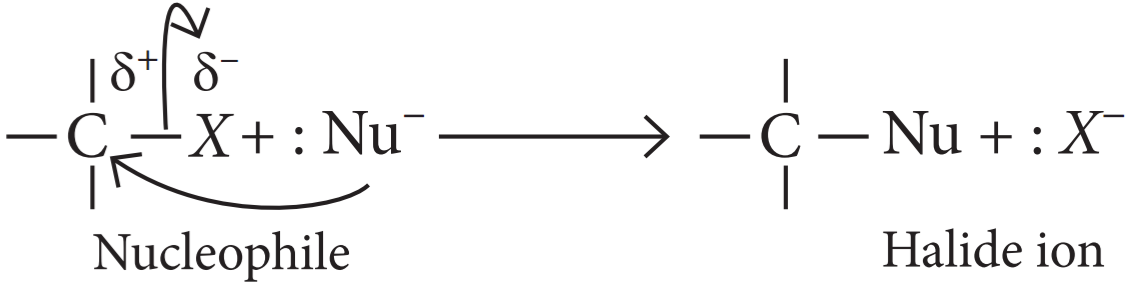
In haloalkanes, when a nucleophile stronger than the halide ion approaches the positively charged carbon atom of an alkyl halide, the halogen atom along with its bonding electron pair gets displaced and a new bond with the carbon and the nucleophile is formed. These reactions are called nucleophilic substitution reactions.

In these reactions the atom or group of atoms which loses its bond from carbon and takes on an additional pair of electrons is called leaving group. Halide ions are good leaving groups. Some important nucleophilic substitution reactions ofhaloalkanes with common nucleophiles are given in the table below.

 
Reagent
Nucleophile (Nu-)
Substitution product R-Nu
Class of main product
1.
NaOH or KOH or moist Ag2O
-OH
ROH
Alcohol
2.
H2O
H2O
ROH
Alcohol
3.
Nal
I-
R – I
Alkyl iodide
4.
R'NH2
$\text{R'}\ddot{\text{N}}\text{H}_2$
RNHR'
Sec. amine
5.
KCN
$\overline{\text{C}}\equiv\text{N}:$
RCN
Nitrile (cyanide)
6.
KNO2
O = N – O-
R – O – N = O
Alkvl nitrite

In these questions (Q. No. i-iv), a statement of assertion followed by a statement ofreason is given. Choose the correct answer out of the following choices.

  1. Assertion and reason both are correct statements and reason is correct explanation for assertion.
  2. Assertion and reason both are correct statements but reason is not correct explanation for assertion.
  3. Assertion is correct statement but reason is wrong statement.
  4. Assertion is wrong statement but reason is correct statement.
  1. Assertion: Alkyl halides are hydrolysed to alcohols by moist silver oxide.

Reason: RCI is hydrolysed to ROH easily but reactions slow down on addition of KI.

  1. Assertion: Alkyl halides fonn alkenes when heated above 300ºC.

Reason: CH3CH21 reacts slowly with strong base as compared to CD3CH2I.

  1. Assertion: RBr reacts with AgNO2 to give nitroalkane.

Reason: Silver nitrite (AgNO2) is an ionic compound, therefore the negative charge on nitrogen is the attacking site.

  1. Assertion: The nucleophilic substitution of vinyl chloride is difficult than ethyl chloride.

Reason: Vinyl group is electron donating group.

  1. Assertion: 2-Bromobutane on reaction with sodium ethoxide in ethanol gives 1-butene as the major product.

Reason: 1-Butene is less stable than 2-butene.