Question
The electrochemical cell shown below is concentration cell.
$M \mid M ^{2+}$ (saturated solution of a sparingly soluble salt, $\left.MX _2\right)\left|\left| M ^{2+}\left(0.001 mol dm ^{-3}\right)\right| M\right.$ The emfof the cell depends on the difference in concentrations of $M ^{2+}$ ions at the two electrodes. The emf of the cell at 298 K is 0.059 V . The following questions are multiple choice questions. Choose the most appropriate answer:
  1. The solubility product ($K_{sp'} mol^3 dm^{-9})$ of $MX_2$ at 298 K based on the information available for the given concentration cell is $(\text{take }2.303 \times \text{R}\times \frac{298}{\text{F}} = 0.059)$
  1. $2 \times 10^{-15}$
  2. $4 \times 10^{-15}​​​​​​​$
  3. $3 \times 10^{-12}​​​​​​​$
  4. $1 \times 10^{-12}​​​​​​​$
  1. The value of $\triangle\text{G}$ (in kJ $mol^{-1}​​​​​​​$) for the given cell is (take $1 F = 96500 C mol^{-1})$
  1. 3.7
  2. -3.7
  3. 10.5
  4. -11.4
  1. The equilibrium constant for the foUowing reaction is:
$\text{Fe}^{2+}+\text{Ce}^{4+}\rightleftharpoons\text{Ce}^{3+}+\text{Fe}^{3+}$

(Given, $\text{E}^\circ_\frac{\text{Ce}^{4+}}{\text{Ce}^{3+}}=1.44\text{V}$ and $\text{E}^\circ_\frac{\text{Fe}^{3+}}{\text{Fe}^{2+}}=0.68\text{V}$)
  1. $7.6 \times 10^{12}$​​​​​​​
  2. $6.5 \times 10^{10}$
  3. $5.2 \times 10^9$
  4. $3.4 \times 10^{12}​​​​​​​$
  1. The solubility product of a saturated solution of $Ag_2CrO_4 $in water at 298 K if the emf of the cell
$Ag|Ag^+ (satd. Ag_2CrO_4 soln) || Ag^+ (0.1 M) | Ag$

is 0.164V at 298 K, is:
  1. $3.359 \times 10^{-12} mol^3 L^{-3}$​​​​​​​
  2. $2.287 \times 10^{-12} mol^3 L^{-3}$
  3. $1.158 \times 10^{-12} mol^3 L^{-3}$
  4. $4.135 \times 10^{-12} mol^3 L^{-3}$
  1. To calculate the emf of the cell, which of the foUowing options is correct?
  1. emf $= E_{cathode}- E_{anode}$​​​​​​​
  2. emf $= E_{anode}- E_{cathode}$
  3. emf $= E_{anode} + E_{cathode}$
  4. None of these.

Answer

  1. (b) $4 \times 10^{-15}$
  1. Explanation:
    $\text{E}_\text{cell}=\frac{0.059}{1}\log\frac{[\text{Ag}^+]_\text{RHS}}{[\text{Ag}^+]_\text{LHS}}$
    $0.164=\frac{0.059}{1}\log\frac{0.1}{[\text{Ag}^+]_\text{LHS}}$
    $[\text{Ag}^+]_\text{LHS}=1.66\times10^{-4}\text{M}$
    So, $[\text{CrO}^{2-}_4]=\frac{1.66\times10^{-4}}{2}$
    $\text{K}_\text{Sp}(\text{Ag}_2\text{CrO}_4)=[\text{Ag}^+]^2[\text{CrO}_4^{2-}]$
    $= (1.66\times10^{-4} )^2\Big(\frac{1.66\times10^{-4}}{2}\Big)$
    $=2.287\times10^{-12} \text{mol}^{3} \text{L}^{-3}$
  2. (a) emf $= E_{cathode}- E_{anode}$
  3. Explanation:
    $\text{E}^\circ_\text{cell}=\frac{0.059}{1}\log\text{K}_\text{C}$
    $\text{E}^\circ_\text{cell}=\text{E}^\circ_\frac{{\text{Fe}^{2+}}}{{\text{Fe}^{3+}}}+\text{E}^\circ_\frac{\text{Ce}^{4+}}{\text{Ce}^{3+}}$
    $= -0.68 + 1.44 = 0.76 \text{V}$
    $\log_{10}\text{K}_\text{C}=\frac{0.76}{0.059}=12.88$
    $\text{K}_\text{C}=7.6\times10^{12}$
  4. (b) 2.287 × 10⁻¹² mol3 L-3
  5. >Explanation:
    $\triangle\text{G}=\text{nFE}=-2\times96500\times0.059$
    = -11387 J mol-1 = -11.4 kJ mol-1
  6. (a) 7.6 × 10¹²
  7. Explanation:
    $0.059=\frac{+0.059}{2}\log\frac{0.001}{[\text{M}^{2+}]}$
    $\log\frac{0.001}{[\text{M}^{2+}]}=2$ or $[\text{M}^{2+}]=10^{-5}$
    Let solubility of sah be S mol/ litre.
    Thus, $\text{MX}_2\xrightarrow{\ \ \ \ }\text{M}^{2+}+2\text{X}^-\\\ \ \text{S}\ \ \ \ \ \ \ \ \ \ \ \ \text{S}\ \ \ \ \ \ \ \ \ \ 2\text{S}$
    $\therefore\text{K}_\text{sp}=4\text{S}^3=4\times(10^{-5})^3=4\times10^{-15}$
  8. (d) -11.4

Need a full question paper?

Generate a complete, print-ready paper with questions like this in minutes — across 16+ boards, with answer keys.

Start Generating Free

Similar questions

Write detailed note on: Starch
Read the passage given below and answer the following questions: Lucas test is a test to differentiate between primary, secondary and tertiary alcohols. This test consists of treating an alcohol with Lucas' reagent, and turbidity, due to the formation of insoluble alkyl chloride, is observed. Lucas test is based on the difference in reacting of three classes of alcohols with hydrogen chloride via $S_N1$ reaction. The different reactivity reflects the differing ease of formation of the corresponding carbocations. In these questions $(Q.$ No. $i-iv),$ a statement of assertion followed by a statement ofreason is given. Choose the correct answer out of the following choices.
  1. Assertion and reason both are correct statements and reason is correct explanation for assertion.
  2. Assertion and reason both are correct statements but reason is not correct explanation for assertion.
  3. Assertion is correct statement but reason is wrong statement.
  4. Assertion is wrong statement but reason is correct statement.
  1. Assertion: Equimolar mixture of cone. $HCI$ and anhydrous $ZnCl_2$ is called Lucas' reagent.
Reason: Lucas' reagent can be used to distinguish between methanol and ethanol.
  1. Assertion: $2-$Methyl$-2-$butanol gives no turbidity with Lucas' reagent at room temperature.
Reason: It is a $3^\circ$ alcohol.
  1. Assertion: Tertiary alcohols react fastest with Lucas' reagent by $S_N1$ mechanism.
Reason: $3^\circ$ carbocation is most stable.
  1. Assertion: Amongst the compounds, $H2C = CHCH_2OH (I), C_6H_5OH (II), CH_3CH_2CH_2OH (III)$ and $(CH_3)_3COH (IV),$ only $(IV)$ reacts with Lucas' reagent at room temperature.
Reason: Tertiary alcohol gives turbidity immediately with Lucas' reagent.
  1. Assertion: Lucas test can be used to distinguish between $1-$propanol and $2-$propanol.
Reason: Lucas test is based upon the difference in reactivity of primary, secondary and tertiary alcohols with cone. HCI and anhyd. $ZnCl_2.$
Electrical work done in unit time is equal to electrical potential multiplied by total charge passed. ln order to obtain maximum work from a cell, the charge has to be passed reversibly. The reversible work done by a cell is equal to decrease in its Gibb's energy. Hence, Gibb's energy of reaction is given by
$\Delta\text{G}=\text{nFE}_\text{cell}$
Hence, Eis the emfof the cell and nFis the amount of energy.
In these questions (Q. No. i-Iv), a statement of assertion followed by a statement ofreason is given. Choose the correct answer out of the following choices.
  1. Assertion and reason both are correct statements and reason is correct explanation for assertion.
  2. Assertion and reason both are correct statements but reason is not correct explanation for assertion.
  3. Assertion is correct statement but reason is wrong statement.
  4. Assertion is wrong statement but reason is correct statement.
  1. Assertion: $\Delta\text{G}^\circ=-\text{nFE}^\circ$
Reason: E should be positive for a spontaneous reaction.
  1. Assertion: An electrochemical cell can be set up only if the red ox reaction is spontaneous.
Reason: A reaction is spontaneous if free energy change is negative.
  1. Assertion: For an electrochemical cell, $\Delta\text{G}<0$ and $\text{E}_\text{cell}>0.$
Reason: The given cell is non-spontaneous.
  1. Assertion: Current stops flowing when $E_{cell} = 0.$
Reason: Equilibrium of the cell reaction is attained.
  1. Assertion: $E_{cell}$ should have a positive value for the cell to function.
Reason: $E_{cell} = E_{cathode} - E_{anode}$
Read the passage given below and answer the following questions:
Fehling's reagent: Fehling's reagent is a mixture of two solutions. Fehllng's solution A is aqueous copper sulphate solution. Fehling's solution Bis alkaline sodium potassium tartarate (Rochelle salt).
$\ \ \ \ \ \ \ \ \ \ \ \ \ \ \ \ \ \ \ \ \text{CH(OH)COONa}\\\text{CuSo}_{4\text{(aq)}}+|\\\ \ \ \ \ \ \ \ \ \ \ \ \ \ \ \ \ \ \ \ \text{CH(OH)COOK}$
It is a mild oxidising agent. It is weaker than Tollens' reagent. It oxidises only aliphatic aldehydes to carboxylate ions and itself gets reduced to reddish brown precipitate of cuprous oxide. Aromatic aldehydes do not respond to Fehling's test. This reaction is used for the test of aliphatic aldehydes known as Fehling's reagent test.
In these questions (Q. No. l-iv), a statement of assertion followed by a statement ofreason is given. Choose the correct answer out of the following choices.
  1. Assertion and reason both are correct statements and reason is correct explanation for assertion.
  2. Assertion and reason both are correct statements but reason is not correct explanation for assertion.
  3. Assertion is correct statement but reason is wrong statement.
  4. Assertion is wrong statement but reason is correct statement.
  1. Assertion: Fehling's solution can be used to distinguish between acetaldehyde and acetone.
Reason: Fehling's reagent is a mixture of two solutions.
  1. Assertion: Aromatic aldehydes can be distinguished from aliphatic aldehydes by Fehling's solution.
Reason: Aromatic aldehydes reduce Fehling's solution, but aliphatic aldehydes do not.
  1. Assertion: Fehling's solution oxidises acetaldehyde to acetic acid but not benzaldehyde to benzoic acid.
Reason: The $C-H$ bond of $-CHO$ group in benzaldehyde is stronger than in acetaldehyde.
  1. Assertion: $CH_3CHO$ and $C_6H_5CH_2CHO$ cannot be distinguished chemically by Fehling's solution.
Reason: $CH_3CHO$ and $C_6H_5CH_2CHO$ cannot be distinguished chemically by Fehling's solution.
  1. Assertion: Formaldehyde, when heated with Fehling's reagent produces a reddish brown ppt, of Cu.
Reason: Fehling's reagent oxidises fonnaldehyde to formate ion.
For the reaction : $2\text{NO}_\text{(g)}+\text{Cl}_{2\text{(g)}}\rightarrow2\text{NOCl}_\text{(g)},$ the following data were collected. All the measurements were taken at $263K.$
Experiment No.
Initial [NO] (M)
Initial $[Cl_2]$ (M)
Initial rate of disapp. of $Cl_2 $ (M/ min)
$1.$
$0.15$
$0.15$
$0.60$
$2.$
$0.15$
$0.30$
$1.20$
$3.$
$0.30$
$0.15$
$2.40$
$4.$
$0.25$
$0.25$
$?$
The following questions are multiple choice questions. Choose the most appropriate answer:
  1. The molecularity of the reaction is:
  1. $1$
  2. $2$
  3. $3$
  4. $4$
  1. The expression for rate law is:
  1. $\text{r}=\text{k}[\text{NO}][\text{Cl}_2]$
  2. $\text{r}=\text{k}[\text{NO}]^2[\text{Cl}_2]$
  3. $\text{r}=\text{k}[\text{NO}][\text{Cl}_2]^2$
  4. $\text{r}=\text{k}[\text{NO}]^2[\text{Cl}_2]^2$
  1. The overall order of the reaction is:
  1. $2$
  2. $0$
  3. $1$
  4. $3$
  1. The value of rate constant is:
  1. $150.32\ M^{-2} \min^{-1}$
  2. $200.08\ M^{-1} \min^{-1}$
  3. $177.77\ M^{-2} \min^{-1}$
  4. $155.75\ M^{-1} \min^{-1}$
  1. The initial rate of disappearance of $Cl_2$ in experiment $4$ is:
  1. $1.75M\ \min^{-1}$
  2. $3.23M\ \min^{-1}$
  3. $2.25M\ \min^{-1}$
  4. $2.77M\ \min^{-1}$
All chemical reactions involve interaction of atoms and molecules. A large number of atoms/molecules are present in a few gram of any chemical compound varying with their atomic/ molecular masses. To handle such large number conveniently, the mole concept was introduced. All electrochemical cell reactions are also based on mole concept. For example, a $4.0$ molar aqueous solution of NaCl is prepared and 500mL of this solution is electrolysed. This leads to the evolution of chlorine gas at one of the electrode. The amount of products formed can be calculated by using mole concept.
The following questions are multiple choice questions. Choose the most appropriate answer:
  1. The total number of moles of chlorine gas evolved is:
  1. $0.5$
  2. $1.0$
  3. $1.5$
  4. $1.9$
  1. If cathode is a Hg electrode, then the maximum weight of amalgam formed from this solution is:
  1. $300g$
  2. $446g$
  3. $396g$
  4. $296g$
  1. The total charge (coulomb) required for complete electrolysis is:
  1. $186000$
  2. $24125$
  3. $48296$
  4. $193000$
  1. In the electrolysis, the number of moles of electrons involved are:
  1. $2$
  2. $1$
  3. $3$
  4. $4$
  1. In electrolysis of aqueous $NaCl$ solution when Pt electrode is taken, then which gas is liberated at cathode?
  1. $H_2$gas
  2. $Cl_2$gas
  3. $O_2$gas
  4. None of these.
In these questions, a statement of assertion followed by a statement of reason is given. Choose the correct answer out of the following choices.
Assertion: The enthalpy of physisorption is lesser than chemisorption.
Reason: Molecules of adsorbate and adsorbent are held by van der Waal's forces in physisorption and by chemical bonds in chemisorption.
Read the passage given below and answer the following questions:
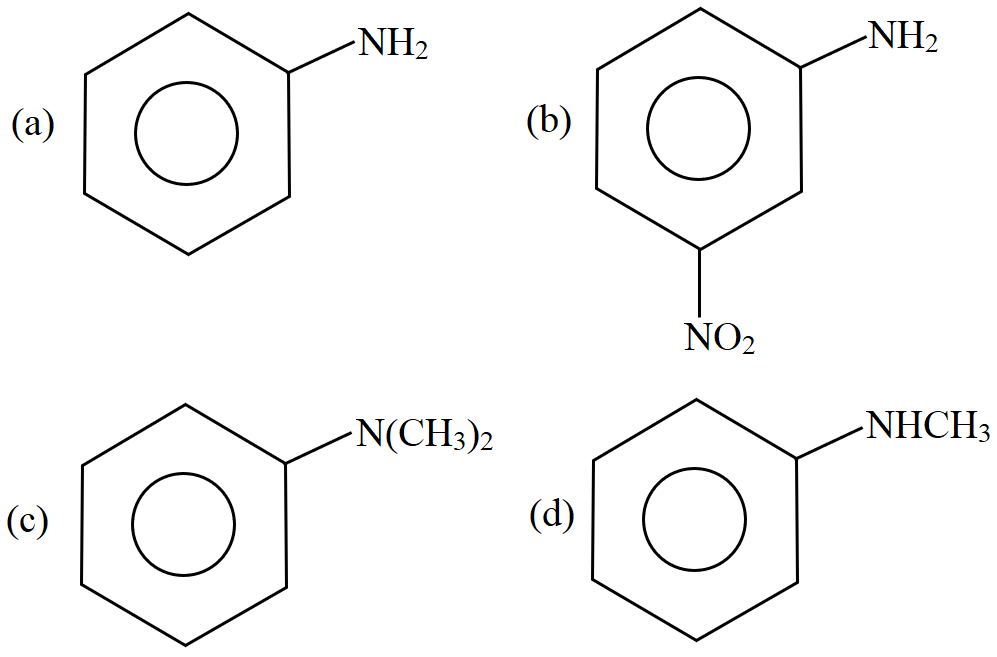
Amines are basic in nature. The basic strength of amines can be expressed by their dissociation constant, $K_b$ or $pK_b$.
$\text{RNH}_2+\text{H}_2\text{O}\rightleftharpoons\text{RNH}^+_3+\text{OH}^-$
$\text{k}_\text{b}=\frac{[\text{RNH}^+_3][\text{OH}^-]}{[\text{RNH}_2]}\text{and}\text{ pk}_\text{b}=-\log\text{k}_\text{b}$
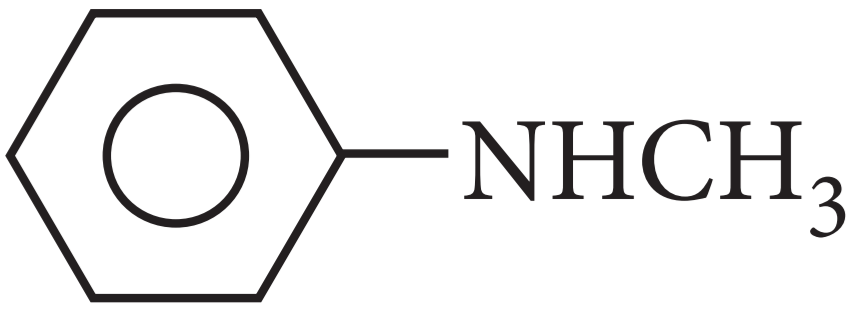
Greater the $K_b$ value or smaller the $pK_b$​​​​​​​ value, more is the basic strength of a mine. Aryl amines such as aniline are less basic than aliphatic amines due to the involvement of lone pair of electrons on N-atom with the resonance in benzene. In derivatives of aniline, the electron releasing groups increase the basic strength while electron withdrawing groups decrease the basic strength. The base weakening effect of electron withdrawing group and base strengthening effect of electron releasing group is more marked at p-position than at m-position. a-Substituted aniline is less basic than aniline due to ortho effect and is probable due to combination of electronic and steric effect.
The following questions are multiple choice questions. Choose the most appropriate answer:
  1. Which of the following has lowest $pK_b$ value?
  1. The strongest base among the following is:
  1. $C_6H_5NH_2$
  2. $p-NO_2 - C_6H_4NH_2$
  3. $m-NO_2 - C_6H_4NH_2$
  4. $C_6H_5CH_2NH_2$
  1. Maximum $pK_b​​​​​​​$​​​​​​​ value of:
  1.  
  1.  
  1. $(CH_3CH_2)_2NH$
  2. $(CH_3)_2NH$
  1. The order of basic strength among the following amines in benzene solution is:
  1. Methylamine is more basic than $NH_3$.
  2. Amines form hydrogen bonds.
  3. Ethylamine has higher boiling point than propane.
  4. Dimethylamine is less basic than methylamine.
  1. $CH_3CH_2NH_2$ contains a basic $-NH_2$ group, but $CH_3CONH_2$​​​​​​​ does not because:
  1. Acetamide is amphoteric in character.
  2. In ethylamine the electron pair on N-atom is delocalised by resonance.
  3. In ethylamine there is no resonance while in acetamide the lone pair of electrons on N-atom is delocalised and is less available for protonation.
  4. None of these.
Dependence of the rate of reaction on the concentration of reactants, temperature, and other factors is the most general method for weeding out unsuitable reaction mechanisms. The term mechanism means all the individual collisional or elementary processes involving molecules $($atoms, radicals, and ions included$)$ that take place simultaneously or consecutively to produce the observed overall reaction. For example, when hydrogen gas reacts with bromine, the rate of the reaction was found to be proportional to the concentration of $H_2$ and to the square root of the concentration of $Br_2.$ Furthermore, the rate was inhibited by increasing the concentration of $HBr$ as the reaction proceeded. These observations are not consistent with a mechanism involving bimolecular collisions of a single molecule of each kind. The currently accepted mechanism is considerably more complicated, involving the dissociation of bromine molecules into atoms followed by reactions between atoms and molecules: It is clear from this example that the mechanism cannot be predicted from the overall stoichiometry. $($source: Moore, $J. W.,$ Pearson, $R. G. (1981).$ Kinetics and mechanism. John Wiley Sons.$)$
$(a).$ Predict the expression for the rate of reaction and order for the following:
$H_2 + Br_2 \rightarrow 2 HBr$
What are the units of rate constant for the above reaction?
$(b).$ How will the rate of reaction be affected if the concentration of $Br_2$ is tripled?
Read the passage given below and answer the following questions: The order of reactivity towards $S_N1$ reaction depends upon the stability of carbocation in the first step. Greater the stability of the carbocation, greater will be its ease of formation from alkyl halide and hence faster will be the rate of the reaction. As we know, $3^\circ$ carbocation is most stable, therefore, the tert-alkyl that halides will undergo $S_N1$ reaction very fast. For example, it has been observed that the reaction $(CH_3)_3CBr$ with $OH^-$ ion to give 2-methyl-2-propanol is about I million times as fast as the corresponding reaction of the methyl bromide to give methanol. The primary alkyl halides always react predominantly by $S_N2$ mechanism. On the other hand, the tertiary alkyl halides react predominantly by $S_N1$ mechanism. Secondary alkyl halides may react by either mechanism or by both the mechanisms without much preference depending upon the nature of the nucleophile and solvent. In these questions (Q. No. i-tv), a statement of assertion followed by a statement of reason is given. Choose tile correct answer out of tile following choices.
  1. Assertion and reason both are correct statements and reason is correct explanation for assertion.
  2. Assertion and reason both are correct statements but reason is not correct explanation for assertion.
  3. Assertion is correct statement but reason is wrong statement.
  4. Assertion is wrong statement but reason is correct statement.
  1. Assertion: Low concentration of nudeophile favours $S_N1$ mechanism.
Reason: $2^\circ$ alkyl halides are less reactive than $1^\circ$ towards $S_N1$ reactions.
  1. Assertion: Polar solvent slows down $S_N2$ reactions.
Reason: $CH_3-Br$ is less reactive than $CH_3Cl.$
  1. Assertion: Benzyl bromide when kept in acetone- water it produces benzyl alcohol.
Reason: The reaction follows $S_N2$ mechanism.
  1. Assertion: Rate of hydrolysis of methyl chloride to methanol is higher in DMF than in water.
Reason: Hydrolysis of methyl chloride follows second order kinetics.
  1. Assertion: $S_N1$ reaction is carried out in the presence of a polar protic solvent.
Reason: A polar protic solvent increases the stability of carbocation due to solvation.