MCQ
The electron affinity values for the halogens show the following trend
  • $F < Cl > Br > I$
  • B
    $F < Cl < Br < I$
  • C
    $F > Cl > Br > I$
  • D
    $F < Cl > Br < I$

Answer

Correct option: A.
$F < Cl > Br > I$
a
(a) Electron affinity value of $Cl$ is greater the $F$ and then decreases down the group.

Need a full question paper?

Generate a complete, print-ready paper with questions like this in minutes — across 16+ boards, with answer keys.

Start Generating Free

Similar questions

Observe the following four solutions :

$P : 10\ ml, 0.1\ M\ NaOH + 5\ ml, 0.1\ M\ HCl$

$Q : 10\ ml, 0.1\ M\ NaOH + 15\ ml, 0.1\ M\ CH_3COOH$

$R : 10\ ml, 0.1\ M\ NH_3 + 10\ ml, 0.1\ M\ NH_4Cl$

$S : 10\ ml, 0.05\ M\ NaF + 5\ ml, 0.1\ M\ HF$

Which of above solutions act as buffer
Aluminium vessels should not be washed with materials containing washing soda since
A filled or half-filled set of $p$ or $d$-orbitals is spherically symmetric. Point out the species which has spherical symmetry
Water is liquid due to
The most suitable method of separation of $1 :1$ mixture of $ortho$ and $para-$ nitrophenols is
At $300\, K$ temperature the standard heat of formation of benzoic acid$_{(s)}, CO_2(g)$  and $H_2O_{(l)}$ are $-408, -393$ and $-286\, KJ \,mol^{-1}$ respectively. At constant pressure the heat of combustion for benzoic acid will be .....$ KJ$
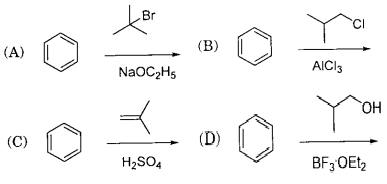
Among the following, reaction($s$) which gives(give) tert-butyl benzene as the major product is(are)
Order of solubility of solid $AgCl(s)$ in given cases.

$(i)$ In pure water

$(ii)$ In presence of $0.1\  M AgNO_3$

$(iii)$ In presence of $2\  M aq.$ solution of $KCN$

$(iv)$  In presence of $ 1\ M aq$. solution of $Ca(CN)_2$

$(v)$ In presence of $2\ M aq.$ solution of $NH_3$ 

(Assuming $100\%$ dissociation of $AgNO_3, KCN$ and $Ca(CN)_2)$ and complex formation with $NH_3$ and $CN^-$ will take place.
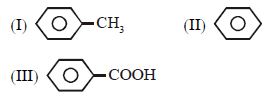
Increasing order of the following for electrophile substitution reaction as
% composition requires ................ of the compound :