MCQ
The electronic configuration of calcium ion $(C{a^{2 + }})$ is
- A$1{s^2},2{s^2}2{p^6},3{s^2}3{p^6},4{s^2}$
- B$1{s^2},2{s^2}s{p^6},3{s^2}3{p^6},4{s^1}$
- C$1{s^2},2{s^2}2{p^6},3{s^2}3{p^6}3{d^2}$
- ✓$1{s^2},2{s^2}2{p^6},3{s^2}3{p^6},4{s^0}$
The calcium atom loses two electrons for the formation of $Ca ^{2+}$.
So, two electrons are removed from the $4 s$ orbital for the formation of $Ca ^{2+}$
Hence, the electronic configuration of $Ca ^{2+}$ is $1 s ^2\, 2 s ^2 \,2 p ^6 \,3 s ^2 \,3 p ^6$.
Generate a complete, print-ready paper with questions like this in minutes — across 16+ boards, with answer keys.
when attached to $sp^3$ hybridised carbon, their leaving group ability in nucleophilic substitution reaction decrease in the order.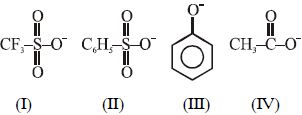
$(1)$ $BeCl _2, CO _2, BCl _3, CHCl _3$
$(2)$ $SO _2, C _6 H _5 Cl , H _2 Se , BrF _5$
$(3)$ $BF _3, O _3, SF _6, XeF _6$
$(4)$ $NO _2, NH _3, POCl _3, CH _3 Cl$