MCQ
The electronic configuration of fluorine is
  • A
    $1{s^2},2{s^2},2{p_x}^1,2{p_y}^1,2{p_z}^1$
  • B
    $1{s^2},2{s^2},2{p_x}^2,2{p_y}^1,2{p_z}^1$
  • $1{s^2},2{s^2},2{p_x}^2,2{p_y}^2,2{p_z}^1$
  • D
    $1{s^2},2{s^2},2{p_x}^2,2{p_y}^2,2{p_z}^2$

Answer

Correct option: C.
$1{s^2},2{s^2},2{p_x}^2,2{p_y}^2,2{p_z}^1$
c

Need a full question paper?

Generate a complete, print-ready paper with questions like this in minutes — across 16+ boards, with answer keys.

Start Generating Free

Similar questions

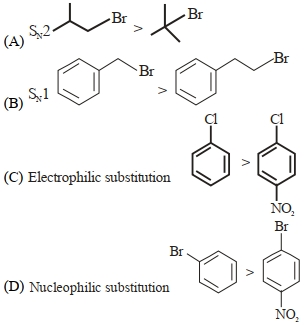
Identify the correct order of reactivity for the following pairs towards the respective mechanism

Choose the correct answer from the options given below:
A system is changed from state $A$  to state $B$  by one path and from $B$  to $A$ another path. If ${E_1}$ and ${E_2}$ are the corresponding changes in internal energy, then
Which ion has maximum magnetic moment
The major product of the following reaction is
$KMnO_4$ reacts with oxalic acid according to the equation : 

$2MnO_4^ -  + 5{C_2}O_4^ -  + 16{H^ + } \to 2M{n^{ +  + }} + 10C{O_2} + 8{H_2}O$ 

Here $20\, mL$ of $0.1\, M\, KMnO_4$ is equivalent to

A pair of stereoisomers might be classified in various ways. Which of the  following statement are true with respect to pairs of stereoisomers?

$(a)$ They might be configurational isomers  $(b)$ They might be diastereomers
$(c)$ They might be constitutional isomers    $(d)$ They might be tautomers
$(e)$ They might be conformational isomers   $(f)$ They might be enantiomers
$(g)$ They might be positional isomers

Compare rate of dehydration of $(i), (ii)$ and $(iii)$ by conc. $H_2SO_4$
The configuration  $1{s^2}2{s^2}2{p^5}3{s^1}$ shows
Calculate standard free energy change for the reaction $\frac{1}{2}Cu(s) + \frac{1}{2}C{l_2}(g)$ $\rightleftharpoons$ $\frac{1}{2}C{u^{2 + }} + C{l^ - }$ taking place at ${25\,^o}C$ in a cell whose standard e.m.f. is $1.02$  volts .............. $\mathrm{J}$
In the following structures, which one is having staggered conformation with maximum dihedral angle?