MCQ
The electronic configuration of four elements are given in brackets$L\,\left( {1{s^2},\,\,2{s^2}2{p^1}} \right);\,\,M\,\left( {1{s^2},\,\,2{s^2}\,2{p^5}} \right)$

$Q\,\left( {1{s^2},\,\,2{s^2}\,2{p^6},\,\,3{s^1}} \right);\,\,R\,\left( {1{s^2},\,\,2{s^2}\,2{p^2}} \right)$The element that would most readily form a diatomic molecule is

  • A
    $Q$
  • $M$
  • C
    $R$
  • D
    $L$

Answer

Correct option: B.
$M$
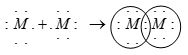
(b) Non-metals readily form diatomic molecules by sharing of electrons. Element $M\,(1{s^2}\,2{s^2}\,2{p^5})$ has seven electrons in its valence shell and thus needs one more electron to complete its octet. Therefore, two atoms share one electron each to form a diatomic molecule $({M_2})$

Need a full question paper?

Generate a complete, print-ready paper with questions like this in minutes — across 16+ boards, with answer keys.

Start Generating Free

Similar questions

The reaction of conc. $HN{O_3}$ and phenol forms
In equilibrium $C{H_3}COOH + {H_2}O$ $\rightleftharpoons$ $C{H_3}COO + H_3 O^ +$ The equilibrium constant may change when
The resistance of conductivity cell containing $0.01\, M\, KCl$ solution at $298\, K$ is $1750 \,\Omega$. If the conductively of $0.01\, M \,KCl$ solution at $298\, K$ is $0.152 \times 10^{-3} \,S \,cm ^{-1}$, then the cell constant of the conductivity cell is $..........\,\times 10^{-3} \,cm ^{-1}$.
The $IUPAC$ symbols for the element with atomic number $119$ would be:
The following data was obtained for chemical reaction given below at $975\, \mathrm{~K}$.

$2 \mathrm{NO}_{(\mathrm{g})}+2 \mathrm{H}_{2(\mathrm{~g})} \rightarrow \mathrm{N}_{2(\mathrm{~g})}+2 \mathrm{H}_{2} \mathrm{O}_{(\mathrm{g})}$


$[NO]$

$\mathrm{mol} \mathrm{L}^{-1}$

${H}_{2}$

$\mathrm{mol} \mathrm{L}^{-1}$

Rate 

$\mathrm{mol}L^{-1}$ $s^{-1}$

$(A)$ $8 \times 10^{-5}$ $8 \times 10^{-5}$ $7 \times 10^{-9}$
$(B)$ $24 \times 10^{-5}$ $8 \times 10^{-5}$ $2.1 \times 10^{-8}$
$(C)$ $24 \times 10^{-5}$ $32 \times 10^{-5}$ $8.4 \times 10^{-8}$

The order of the reaction with respect to $\mathrm{NO}$ is ..... .

Identify major product of the reaction, when the given compound is hydrolysed  and heated strongly
Which of the following has been arranged in order of decreasing dipole moment ?
The number of moles of sodium oxide in $620\,g$ of it is ................ $\mathrm{moles}$
As one moves along a given row in the periodic table, ionization energy
The incorrect stability order of $+3$ and $+1$ states of $13^{th}$ group elements (boron family) is