MCQ
The electronic configuration of four elements are given in brackets$L\,\left( {1{s^2},\,\,2{s^2}2{p^1}} \right);\,\,M\,\left( {1{s^2},\,\,2{s^2}\,2{p^5}} \right)$

$Q\,\left( {1{s^2},\,\,2{s^2}\,2{p^6},\,\,3{s^1}} \right);\,\,R\,\left( {1{s^2},\,\,2{s^2}\,2{p^2}} \right)$The element that would most readily form a diatomic molecule is

  • A
    $Q$
  • $M$
  • C
    $R$
  • D
    $L$

Answer

Correct option: B.
$M$
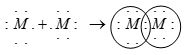
(b) Non-metals readily form diatomic molecules by sharing of electrons. Element $M\,(1{s^2}\,2{s^2}\,2{p^5})$ has seven electrons in its valence shell and thus needs one more electron to complete its octet. Therefore, two atoms share one electron each to form a diatomic molecule $({M_2})$

Need a full question paper?

Generate a complete, print-ready paper with questions like this in minutes — across 16+ boards, with answer keys.

Start Generating Free

Similar questions

Match List $I$ with List $II$

List-$I$ (Elements) List-$II$(Properties in their respective groups)
$A$ $\mathrm{Cl}, \mathrm{S}$ $I$ Elements with highest electronegativity
$B$ $\mathrm{Ge}, \mathrm{As}$ $II$ Elements with largest atomic size
$C$ $\mathrm{Fr}, \mathrm{Ra}$ $III$ Elements which show properties of both metals and non metal
$D$ $\mathrm{F}, \mathrm{O}$ $IV$ Elements with highest negative electron gain enthalpy

Choose the correct answer from the options given below :

The ion that has $sp^3d^2$ hybridization for the central atom is
If a compound on analysis was found to contain $C = 18.5\%$, $H = 1.55\%$, $Cl = 55.04\%$, $O = 24.81\%$, then its empirical formula is
The $IUPAC$ name of  (figure) is
Which one of the following given graphs represents the variation of rate constant $(\mathrm{k})$ with temperature $(T)$ for an endothermic reaction ?
In the following reaction $H{C_2}{O_4}^ - + P{O_4}^{3- } $ $\rightleftharpoons$ $ HP{O_4}^{ 2- } + {C_2}{O_4}^{ 2- }$ Which are the two Bronsted bases
The electronic configuration of four elements $L, P, Q$ and $R$ are given in brackets $L\,\left( {1{s^2},\,\,2{s^2}\,2{p^4}} \right);\,\,Q\,\left( {1{s^2},\,\,2{s^2}\,2{p^6},\,\,3{s^2}\,\,3{p^5}} \right)$;$P$

$\,\left( {1{s^2},\,\,2{s^2}\,2{p^6},\,\,3{s^1}} \right);\,\,R\,\left( {1{s^2},\,\,2{s^2}\,2{p^6},\,\,3{s^2}} \right)$The formula of ionic compounds that can be formed between these elements are

Petroleum ether can be used as
Which of the following attacks glass
Which of the following having delocalised electrons?