MCQ
The electronic configuration of three elements $A,B$ and $C$ are given below. The molecular formula of the compound formed from $B$ and $C$ will be

$A : 1s^2\, 2s^2\, 2p^6$

$B : 1s^2\, 2s^2\, 2p^6\, 3s^2\, 3p^3$

$C : 1s^2\, 2s^2\, 2p^6\, 3s^2\, 3p^5$

  • A
    $BC$
  • B
    $B_2C$
  • C
    $BC_2$
  • $BC_3$

Answer

Correct option: D.
$BC_3$
d
$B$ represents phosphorus $P$ and $C$ represents Chlorine $Cl$. The compound formed is $PCl _3$ i.e., $BC _3$.

Need a full question paper?

Generate a complete, print-ready paper with questions like this in minutes — across 16+ boards, with answer keys.

Start Generating Free

Similar questions

$20 \%$ of acetic acid is dissociated when its $5\,g$ is added to $500\,mL$ of water. The depression in freezing point of such water is $.....\times 10^{-3} \;{ }^{\circ} C$. Atomic mass of $C , H$ and $O$ are $12,1$ and $16\,a.m.u.$ respectively.

[Given : Molal depression constant and density of water are $1.86\, K\, kg\, mol^{-1}$ and $1\, g\, cm^{-3}$ respectively.]

The mass of a substance liberated when a charge '$q$' flows through an electrolyte is proportional to
Which one has the highest boiling point ?
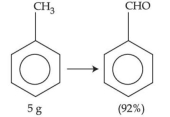
In the above reaction, $5\,g$ of toluene is converted into benzaldehyde with $92 \%$ yield. The amount of benzaldehyde produced is $....\times 10^{-2}\,g$. (Nearest integer)
Which of the following species is not expected to be a ligand
The tendency to form monovalent compounds among the Group $13$ elements is correctly exhibited in :
In an electroplating experiment $mg$ of silver is deposited, when $4 $ amperes of current flows for $2 $ minutes. The amount (in $gms$) of silver deposited by $ 6$  amperes of current flowing for $40$  seconds will be
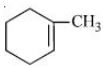
$[Figure]$  $\mathop {\xrightarrow{{\,\,\,\,\,\,\,\,\,cold\,\,\,\,\,}}}\limits_{alkaline\,KMn{O_4}} A\mathop {\xrightarrow{{Cr{O_3}}}}\limits_{AcOH} B$

$A$ and $B$ are :

The decomposition of formic acid on gold surface follows first order kinetics. If the rate constant at $300\, K$ is $1.0 \times 10^{-3} s ^{-1}$ and the activation energy $E _{ a }=11.488\, kJ\, mol ^{-1},$ the rate constant at $200\, K$ is ............  $\quad \times 10^{-5} s ^{-1} .$

(Round of to the Nearest Integer).

(Given : $\left. R =8.314\, J\, mol ^{-1} K ^{-1}\right)$