MCQ
The electronic configuration of three elements $A,B$ and $C$ are given below. The molecular formula of the compound formed from $B$ and $C$ will be

$A : 1s^2\, 2s^2\, 2p^6$

$B : 1s^2\, 2s^2\, 2p^6\, 3s^2\, 3p^3$

$C : 1s^2\, 2s^2\, 2p^6\, 3s^2\, 3p^5$

  • A
    $BC$
  • B
    $B_2C$
  • C
    $BC_2$
  • $BC_3$

Answer

Correct option: D.
$BC_3$
d
$B$ represents phosphorus $P$ and $C$ represents Chlorine $Cl$. The compound formed is $PCl _3$ i.e., $BC _3$.

Need a full question paper?

Generate a complete, print-ready paper with questions like this in minutes — across 16+ boards, with answer keys.

Start Generating Free

Similar questions

Heat of neutralisation for the given reaction $NaOH + HCl \to NaCl + {H_2}O$ is $57.1\,kJ\,mo{l^{ - 1}}$. What will be the heat released when $0.25\,mole$ of $NaOH$ is titrated against $0.25\,mole$ of $HCl$ .......$kJ\,mo{l^{ - 1}}$
Which expression is correct for the work done in adiabatic reversible expansion of an ideal gas
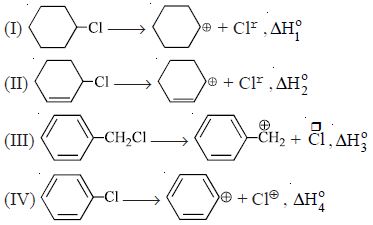
For the below reactions :

The correct decreasing order of enthalpies of reaction for producing carbocation is

The mass of the proton is $1840$ times that of electron. If a proton is accelerated through a potential difference of $V$ volts, the kinetic energy of the proton would be
Given configuration are for element $X, Y$ and $Z$, configuration are ions of $X$
$X = (Ne)\, 3s^2\, 3p^5$
$Y = (Ne)\, 3s^2\, 3p^6$
$Z = (Ne)\, 3s^2\, 3p^4$
then.
Which of the following has the square planar structure?
$25\, g$ of a solute of molar mass $250\, g\, mol^{-1}$ is dissolved in $100\, ml$ of water to obtain a solution whose density is $1.25\, g\, ml^{-1}$. The molarity and molality of the solution are respectively
The geometry of the molecule with $s{p^3}{d^2}$ hybridised central atom is
A molecule may be represented by three structures having energies $E_1 , E_2$ and $E_3$ , respectively. The energies of these structures follow the order $E_3 < E_2 < E_1$ , respectively. If the experimental bond energy of the molecule is $E_0$ , the resonance energy is
Calculate $\Delta  H$ when $2\  moles$ of solid benzoic acid undergo complete combustion at $300\,K$ if $C_6H_5COOH_{(s)} + \frac{15}{2} O_2 (g) \rightarrow 7CO_2(g) + 3H_2O(l)$ $\Delta  U_{reaction} = - 750\  kJ/mole$ [$R = 8 \ Joule/ mole-K$] .........$kJ$