MCQ
The electrostatic potential on the surface of a charged conducting sphere is 100V. Two statments are made in this regard:
S1 : At any point inside the sphere, electric intensity is zero.
S2 : At any point inside the sphere, the electrostatic potential is 100V.
Which of the following is a correct statement?
  • A
    S1 is true but S2 is false.
  • B
    Both S1 & S2 are false.
  • C
    S1 is true, S2 is also true and S1 is the cause of S2.
  • D
    S1 is true, S2 is also true but the statements are independant.
Answer

  1. S1 is true, S2 is also true and S1 is the cause of S2.

We know, the electric field intensity E and electric potential V are related $\text{E}=\frac{\text{dV}}{\text{dr}}$.
If electric field intensity  E= 0, then $\frac{\text{dV}}{\text{dr}}=0$.  It means, E = 0 inside the charged conducting sphere causes uniform potential inside the sphere. Hence uniform electrostatic potential 100 V will be at any point inside the sphere.

Important points:

  1. The electric field zero does not necessary imply that electric potential is zero. E.g., the electric field intensity at any point inside the charged spherical shell is zero but there may exist non-zero electric potential.
  2. If two charged particles of same magnitude but opposite sign are placed, the electric potential at the midpoint will be zero but electric field is not equal to zero.

Need a full question paper?

Generate a complete, print-ready paper with questions like this in minutes — across 16+ boards, with answer keys.

Start Generating Free

Similar questions

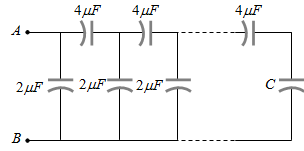
A finite ladder is constructed by connecting several sections of 2μF,4 μF  capacitor combinations as shown in the figure. It is terminated by a capacitor of capacitance C. What value should be chosen for C such that the equivalent capacitance of the ladder between the points A and B becomes independent of the number of sections in between

(a) 4μF

(b) 2 μF

(c) 18 μF

(d) 6 μF

Velocity of sound in air is 332m/s. Its velocity in vacuum will be:
  1. > 332m/s
  2. = 332 m/s
  3. < 332m/s
  4. Meaningless.

Consider an NPN transistor amplifier in common-emitter configuration. The current gain of the transistor is 100. If the collector current changes by 1 mA, what will be the change in emitter current

(a) 1.1 mA

(b) 1.01 mA

(c) 0.01 mA

(d) 10 mA

The minimum temperature of a body at which it emits light is

(a) 1200°C

(b) 1000°C

(c) 500°C

(d) 200°C

A metallic surface with work function of 2 eV, on heating to a temperature of 800 K gives an emission current of 1 mA. If another metallic surface having the same surface area, same emission constant but work function 4 eV is heated to a temperature of 1600 K, then the emission current will be

(a) 1 mA

(b) 2 mA

(c) 4 mA

(d) None of these

Non polar molecules has:
A charged particle moves through a magnetic field perpendicular to its direction. Then:
When you speak to your friend, which of the following parameters have a unique value in the sound produced?
  1. Frequency.
  2. Wavelength.
  3. Amplitude.
  4. Wave velocity.
A wire elongates by 1.0mm when a load W is hung from it. If this wire goes over a a pulley and two weights W each are hung at the two ends, he eloogation of he wire will be:
  1. 0.5m
  2. 1.0mm
  3. 2.0mm
  4. 4.0mm.

Angle of minimum deviation for a prism of refractive index 1.5 is equal to the angle of prism. The angle of prism is (cos 41° = 0.75)

(a) 62°

(b) 41°

(c) 82°

(d) 31°