MCQ
The element having atomic number 33 is present in which group of periodic table?
  • A
    Group 16
  • Group 15
  • C
    Group 17
  • D
    Group 18

Answer

Correct option: B.
Group 15
B

Need a full question paper?

Generate a complete, print-ready paper with questions like this in minutes — across 16+ boards, with answer keys.

Start Generating Free

Similar questions

Which of the following salts on dissolution in water gives $pH$ less than $7$ at $298\, K $?
Based on the following thermochemical equations

${H_2}O(g) + C(s) \to CO(g) + {H_2}(g);\,\Delta H = 131\,kJ$$CO(g) + \frac{1}{2}{O_2}(g) \to C{O_2}(g);\Delta H = - 282\,kJ$

${H_2}(g) + \frac{1}{2}{O_2}(g) \to {H_2}O(g);\,\Delta H = - 242\,kJ$

$C(s) + {O_2}(g) \to C{O_2}(g);\,\Delta H = X\,kJ$ The value of $X$ is ......$kJ$

At room temperature solid paraffin is
Name the alkene with molecular formula ${C_{10}}{H_{20}}$
Given below are two statements: one is labelled as Assertion $A$ and the other is labelled as Reason $R$.

Assertion $A$ : Boric acid is a weak acid

Reason $R$ : Boric acid is not able to release $H ^{+}$ion on its own. It receives $OH ^{-}$ion from water and releases $H ^{+}$ion.

In the light of the above statements, choose the most appropriate answer from the options given below.
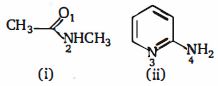
The preferred sites of protonation in the following compounds are
A mixture of 24dm3 of hydrogen and 100dm3 of oxygen was ignited and the reaction mixture was cooled to room temperature and pressure. What will be volume of gases remaining of the end of the reaction?
An organic compound $C_8H_{12}$ on ozonolysis give $2\, moles$ of $3\,-$ oxobutanal. Then the structure of compound can not be
When $1\ gm$ equivalent of strong acid reacts with strong base heat released is $13.5\ Kcal$ .  when $1\ gm$ equivalent $H_2A$ is completely neutralised against strong base $13\ Kcal$ is released. When $1\ gm$ equivalent $B(OH)_2$ is  completely neutralised against strong acid $10\ Kcal$ heat is released. Calculate enthalpy change when $1\ mole\ H_2A$ is completely neutralised by $B(OH)_2$........$K\,cal$
The right option for the mass of $CO _2$ produced by heating $20 g$ of $20 \%$ pure limestone is $........\,g$(Atomic mass of $Ca =40$ )$\left[ CaCO _3 \stackrel{1200 K }{\longrightarrow} CaO + CO _2\right]$