MCQ
The element that does $NOT$ show catenation is
  • A
    $Ge$
  • B
    $Si$
  • C
    $Sn$
  • $Pb$

Answer

Correct option: D.
$Pb$
d
Due to the lowest bond energy of $Pb -Pb$ bond.

Need a full question paper?

Generate a complete, print-ready paper with questions like this in minutes — across 16+ boards, with answer keys.
Start Generating Free

Similar questions

Which of the following is a meso compound ?
Which one of the following compounds does not react with bromine
In the conversion of $N_2$ into $N_2^+$ the electron will be lost from which of the following molecular orbital ?
$0.02\,mole$ of $[Co(NH_3)_5Br]Cl_2$ and $0.02\,mole$ of $[Co(NH_3)_5Cl]SO_4$ are present in $200 \,cc$ of a solution $X$. The number of moles of the precipitates $Y$ and $Z$ that are formed when the solution $X$ is treated with excess silver nitrate and excess barium chloride are respectively
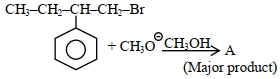
The major product $(A)$ formed in the reaction given below is:
  Oxidation number of cobalt in $K[Co{(CO)_4}]$ is
The substances used for the preparation of ether by Williamson's synthesis are
Class $XII$ students were asked to prepare one litre of buffer solution of $pH\,8.26$ by their chemistry teacher. The amount of ammonium chloride to be dissolved by the student in $0.2\,M$ ammonia solution to make one litre of the buffer is $.....\,g$ (Given $pK _{ b }\left( NH _{3}\right)=4.74$; Molar mass of $NH _{3}=17\,g\,mol ^{-}$ ; Molar mass of $NH _{4} Cl =53.5\,g\,mol ^{-1}$ )
The $IUPAC$ name of the compoundis

$\begin{array}{*{20}{c}}
  {C{H_3} - C = CH - C{H_2} - COOH} \\ 
  {|\,\,\,\,\,\,\,\,\,\,\,\,\,\,\,\,\,\,\,\,\,\,\,\,\,\,\,\,\,\,\,\,\,\,\,\,\,\,\,\,\,} \\ 
  {OH\,\,\,\,\,\,\,\,\,\,\,\,\,\,\,\,\,\,\,\,\,\,\,\,\,\,\,\,\,\,\,\,\,\,\,\,\,\,} 
\end{array}$

The rate of the reaction $2{N_2}{O_5} \to 4N{O_2} + {O_2}$ can be written in three ways

$\frac{{ - d\left[ {{N_2}{O_5}} \right]}}{{dt}} = k\left[ {{N_2}{O_5}} \right]$ , 

$\frac{{d\left[ {N{O_2}} \right]}}{{dt}} = k'\left[ {{N_2}{O_5}} \right]$,

$\frac{{d\left[ {{O_2}} \right]}}{{dt}} = k''\left[ {{N_2}{O_5}} \right]$

The relationship between $k$ and $k'$ and between $k$ and $k^{"}$ are