Question
The element which forms a basis oxide has the atomic number of:
  1. 18.
  2. 17.
  3. 14.
  4. 19.

Answer

  1. 19.

Explanation:

Potassium (K) forms a basic oxide and has an atomic number of 19. The atomic numbers of 18, 17 and 14 correspond to acidic oxides.

Need a full question paper?

Generate a complete, print-ready paper with questions like this in minutes — across 16+ boards, with answer keys.
Start Generating Free

Similar questions

Which of the following is an iron ore?
  1. Cinnabar.
  2. Calamine.
  3. Haematite.
  4. Rock salt.
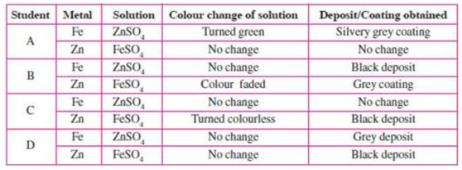
Aqueous solutions of zinc sulphate and iron sulphate were taken in test tubes I and II by four students A,  B,  C and D . Metal pieces of iron and zinc were dropped in the two solutions and observations made after several hours were recorded in the form of table as given below:
Image
The correct reporting has been made in observations:
Which of the following are present in a dilute aqueous solution of hydrochloric acid?
The rechargeable battery used in a mobile phone hand set is usually:
  1. Lead ion battery.
  2. Sodium ion battery.
  3. Hydrogen ion battery.
  4. Lithium ion battery.
Which among the following statement (s) is/ are true? Exposure of silver chloride to sunlight for a long duration turns grey due to:
  1. The formation of silver by decomposition of silver chloride.
  2. Sublimation of silver chloride.
  3. Evolution of chlorine gas from silver chloride.
  4. Oxidation of silver chloride.
Generally, non-metals are not conductors of electricity. Which of the following is a good conductor of electricity?
Which of the following statements is correct about an aqueous solution of an acid and of a base?
  1. Higher the pH, stronger the acid.
  2. Higher the pH, weaker the acid.
  3. Lower the pH, stronger the base.
  4. Lower the pH, weaker the base.
    A student adds a few drops of ethanoic acid to test tubes X, Y and Z containing aqueous solutions of sodium chloride, sodium hydroxide and sodium carbonate respectively. If he now brings a burning splinter near the mouth of the test tubes immediately after adding the ethanoic acid in each one of them, in which of the test tube or test tubes the flame gets extinguished?
    Manganese metal is extracted from manganese dioxide by a reduction process by making use of:
    1. Carbon.
    2. Hydrogen.
    3. Electrolysis.
    4. Aluminium.