MCQ
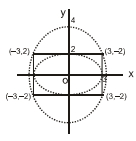
The ellipse $E_1: \frac{x^2}{9}+\frac{y^2}{4}=1$ is inscribed in a rectangle $R$ whose sides are parallel to the coordinate axes.

Another ellipse $E _2$ passing through the point $(0,4)$ circumscribes the rectangle $R$.. The eccentricity of the ellipse $E _2$ is

  • A
    $\frac{\sqrt{2}}{2}$
  • B
    $\frac{\sqrt{3}}{2}$
  • $\frac{1}{2}$
  • D
    $\frac{3}{4}$

Answer

Correct option: C.
$\frac{1}{2}$
c
Let required ellipse is

$E_2: \frac{x^2}{a^2}+\frac{y^2}{b^2}=1$

It passes thorugh $(0,4)$

$0+\frac{16}{b^2}=1 \quad \Rightarrow \quad b^2=16$

It also passes through $( \pm 3, \pm 2)$

$\frac{9}{a^2}+\frac{4}{b^2}=1 $

$\frac{9}{a^2}+\frac{1}{4}=1 $

$\frac{9}{a^2}=\frac{3}{4} \quad \Rightarrow \quad a^2=b^2\left(1-e^2\right) $

$\frac{12}{16}=1-e^2 $

$e^2=1-\frac{12}{16}=\frac{4}{16}=\frac{1}{4} $

$e=\frac{1}{2}$

Need a full question paper?

Generate a complete, print-ready paper with questions like this in minutes — across 16+ boards, with answer keys.

Start Generating Free

Similar questions

The equation of the line which cuts off the intercepts $2a\sec \theta $ and $2a\,{\rm{cosec}}\,\theta $ on the axes is
Locus of the point, the difference of the squares of lengths of tangents drawn from which to two given circles is constant, is
For $0 < \phi < \frac{\pi }{2},$ if $x = \sum\limits_{n = 0}^\infty {{{\cos }^{2n}}\phi ,} $ $y = \sum\limits_{n = 0}^\infty {{{\sin }^{2n}}\phi ,} $ $z = \sum\limits_{n = 0}^\infty {{{\cos }^{2n}}\phi \,{{\sin }^{2n}}\phi ,} $ then
Let  $ p, q, r $ be three mutually perpendicular vectors of the same magnitude. If a vector $x$  satisfies equation $p \times \{ (x - q) \times p\} + q \times \{ (x - r) \times q\} + r \times \{ (x - p) \times r\} = 0,$ then $ x$  is given by
The number of non-zero terms in the expansion of ${(1 + 3\sqrt 2 x)^9} + {(1 - 3\sqrt 2 x)^9}$ is
If $A = \left[ {\begin{array}{*{20}{c}}1&0\\1&1\end{array}} \right]$ and $I = \left[ {\begin{array}{*{20}{c}}1&0\\0&1\end{array}} \right]$, then which one of the following holds for all $n \ge 1$, (by the principal of mathematical induction)
Consider an infinite $G.P. $ with first term a and common ratio $r$, its sum is $4$ and the second term is $3/4$, then
Consider the sets $\mathrm{A}=\left\{(\mathrm{x}, \mathrm{y}) \in \mathbb{R} \times \mathbb{R}: \mathrm{x}^{2}+\mathrm{y}^{2}=25\right\}$, $B=\left\{(x, y) \in \mathbb{R} \times \mathbb{R}: x^{2}+9 y^{2}=144\right\}, C=\{(x, y)$ $\left.\in \mathbb{Z} \times \mathbb{Z}: x^{2}+y^{2} \leq 4\right\}$, and $D=A \cap B$. The total number of one-one functions from the set D to the set C is :
Let $A =\left(\begin{array}{ll}2 & -2 \\ 1 & -1\end{array}\right)$ and $B =\left(\begin{array}{ll}-1 & 2 \\ -1 & 2\end{array}\right)$. Then the number of elements in the set $\left\{( n , m ): n , m \in\{1,2, \ldots . .10\}\right.$ and $\left.nA ^{ n }+ mB ^{ m }= I \right\}$ is
Let $A B$ be a line segment of length $2$ . Construct a semicircle $S$ with $A B$ as diameter. Let $C$ be the mid-point of the $\operatorname{arc} A B$. Construct another semicircle $T$ external to the $\triangle A B C$ with chord $A C$ as diameter. The area of the region inside the semi-circle $T$ but outside $S$ is