Question
The EMF of a cell can be defined as:

Answer

  1. All the above.
Explanation:
EMF of cell can be defined as:
→ Workdone in taking unit positive charge once round the circuit.
→ The open circuit voltage of cell.
→ The terminal voltage when current is zero.

Need a full question paper?

Generate a complete, print-ready paper with questions like this in minutes — across 16+ boards, with answer keys.
Start Generating Free

Similar questions

A current $i$ ampere flows along the inner conductor of a coaxial cable and returns along the outer conductor of the cable, then the magnetic induction at any point outside the conductor at a distance $r$ metre from the axis is
If a power of 100 W is being supplied across a potential difference of 200 V, current flowing is(a) 2 A(b) 0.5 A(c) 1 A(d) 20 A
       
The ratio between Bohr radii is:
The high temperature required to initiate the nuclear fusion reaction is to overcome the _______ present between the atoms.
A charged particle moves in a uniform magnetic field. The velocity of the particle at some instant makes an acute angle with the magnetic field. The path of the particle will be:
Points A and B are situated perpendicular to the axis of a 2cm long bar magnet at large distances X and 3X from its centre on opposite sides. The ratio of the magnetic fields at A and B will be approximately equal to(a) 1 : 9(b) 2 : 9(c) 27 : 1(d) 9 : 1
       
A long straight horizontal cable carries a current of 2.5 A in the direction 10° south of west to 10° north of east. The magnetic meridian of the place happens to be 10° west of the geographic meridian. The earth’s magnetic field at the location is 0.33 Gauss, and the angle of dip is zero. Locate the line of neutral points. (Ignore the thickness of the cable).
 The rate of flow of electric charge through any cross-section of a conductor is known as __________.
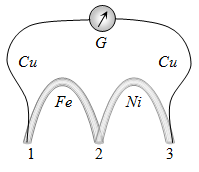
Three wires of copper, iron and nickel are joined to form three junctions as shown in Fig. When the temperature of junction $1$ is kept $50℃$ with the other two junctions at $0℃$, the sensitive galvanometer gives a deflection of $14$ divisions. When the temperature of junction $3$ is kept $50℃,$ with the other two junctions at $0℃,$ the galvanometer gives a deflection of $11$ divisions. Then the deflection given by the galvanometer, when temperature of the junction $2$ is kept at $50℃,$ with the other two junctions at $0℃,$ will be
A circular coil and a bar magnet moves with the same velocity. Then