MCQ
The energy contained in a small volume through which an electromagnetic wave is passing oscillates with:
  • A
    Zero frequency.
  • B
    The frequency of the wave.
  • C
    Half the frequency of the wave.
  • Double the frequency of the wave.

Answer

Correct option: D.
Double the frequency of the wave.
The energy per unit volume of an electromagnetic wave,
$\text{u}=\frac{1}{2}\in_0\text{E}^2+\frac{\text{B}^2}{2\mu_0}$
The energy of the given volume can be calculated by multiplying the volume with the above expression.
$\text{U}=\text{u}\times\text{V}=\Big(\frac{1}{2}\in_0\text{E}^2+\frac{\text{B}^2}{2\mu_0}\Big)\times\text{V}\ ....(\text{i})$
Let the direction of propagation of the electromagnetic wave be along the z-axls. Then, the electric and magnetic fields at a particular point are given by,
$\text{E}_\text{x}=\text{E}_0\sin(\text{kz}-\omega\text{t})$
$\text{B}_\text{y}=\text{B}_0\sin(\text{kz}-\omega\text{t})$
Substituting the values of electric and magnetic fields in (1) we get,
$\text{U}=\Big(\frac{1}{2}\in_0\big(\text{E}_0^2\sin^2(\text{kz}-\omega\text{t})+\frac{\text{B}^2_0\sin^2(\text{kz}-\omega\text{t})}{2\mu_0}\Big)\times\text{V}$
$\text{U}=\Big(\in_0\text{E}^2_0\frac{(1-\cos(2\text{kz}-2\omega\text{t}))}{4}+\frac{\text{B}_0^2(1-\cos(2\text{kz}-2\omega\text{t}))}{4\mu_0}\Big)\times\text{V}$
From the above expression, it can be easily understood that the energy of the electric and magnetic fields have angular frequency $2\omega$ Thus. the frequency of the energy of the electromagnetic wave will also be double.

Need a full question paper?

Generate a complete, print-ready paper with questions like this in minutes — across 16+ boards, with answer keys.
Start Generating Free

Similar questions

A charged particle moves in a uniform magnetic field. The velocity of the particle at some instant makes an acute angle with the magnetic field. The path of the particle will be:
The mass of a neutral carbon atom in ground state is:
Two particles having position vectors $\overrightarrow {{r_1}} = (3\hat i + 5\hat j)$ metres and $\overrightarrow {{r_2}} = ( - 5\hat i - 3\hat j)$ metres are moving with velocities ${\overrightarrow v _1} = (4\hat i + 3\hat j)\,m/s$ and ${\overrightarrow v _2} = (\alpha \,\hat i + 7\hat j)$ $m/s.$ If they collide after $2$  seconds, the value of $'\alpha '$ is
The resultant of $\vec A$ and $\vec B$ makes an angle $\alpha $ with $\vec A$ and $\beta $ with $\vec B$,
An ideal gas is compressed to half its initial volume by means of several processes. Which of the process results in the maximum work done on the gas? 
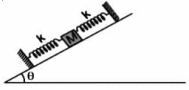
In the adjacent figure, if the incline plane is smooth and the springs are identical, then the period of oscillation of this body is
A body of mass $2\, kg$ moving with a velocity $\left( {\hat i + \hat j + \hat k} \right)\,m/s$ collides with another body of mass $5\, kg$ moving with velocity $\left( {\hat i - 2\hat j + 3\hat k} \right)\,m/s$. If they stick together, the velocity (in $m/s$) of the composite body is 
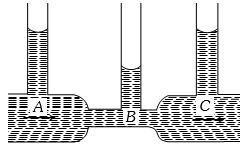
In the following fig. is shown the flow of liquid through a horizontal pipe. Three tubes $A, B$  and $ C$  are connected to the pipe. The radii of the tubes $A, B $ and $C$  at the junction are respectively $ 2 cm, 1 cm$   and $2 cm.$  It can be said that the
Consider the following statements:
  1. An $\text{emf}$ can be induced by moving a conductor in a magnetic field.
  2. An $\text{emf}$ can be induced by changing the magnetic field.
Position $x$ of a particle at any instant is related with velocity as $v = \sqrt {2x + 9}$ . The particle starts from origin. Then initial acceleration and velocity are