MCQ
The energy that opposes dissolution of a solvent is
  • A
    Hydration energy
  • B
    Lattice energy
  • C
    Internal energy
  • Bond energy

Answer

Correct option: D.
Bond energy
d
Lattice energy opposes the dissolution of a solvent. Lattice energy is the amount of energy required to dissociate $1\, mole$ of ionic crystal into ions.If the hydrated energy of solid is more than lattice energy, then slid dissolves.

Need a full question paper?

Generate a complete, print-ready paper with questions like this in minutes — across 16+ boards, with answer keys.
Start Generating Free

Similar questions

Which one of the statement of quantum numbers is false?
For the gaseous reaction, ${N_2}{O_4} \to 2N{O_2}$
Which of the following is slow process:
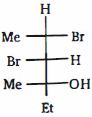
Which of the following is the enantiomer of the compound shown below ?
Which of the following quantities can only be a whole number?
A gas decolourised by $KMn{O_4}$ solution but gives no precipitate with ammoniacal cuprous chloride is
Find the concentration of ion which is first precipitated at the point when the third ion starts precipitating, if $AgNO_3$ is added gradually to the solution that contains $0 .1\ M\  Cl^-, 0 .1\  M\ Br^-$ and $0. 1\ M\ I^-$

Given that

Salt            ||         $K_{sp}$

$AgCl$        ||        $2 \times {10^{ - 10}}$

$AgBr$       ||       $5 \times {10^{ - 13}}$

$Ag$           ||        $9 \times {10^{ - 17}}$

The formation of the oxide ion, ${O^{2 - }}\left( g \right)$, from oxygen atom requires first an exothermic and then an endothermic step as shown below

$O\left( g \right) + {e^ - } \to O_{\left( g \right)}^ - \,\,\,\,;\,\,\,\,{\Delta _f}{H^\Theta } =  - 141\,kJ\,mo{l^{ - 1}}$

${O^ - }\left( g \right) + {e^ - } \to O_{\left( g \right)}^{2 - }\,\,\,\,;\,\,\,\,{\Delta _f}{H^\Theta } =  + 780\,kJ\,mo{l^{ - 1}}$

Thus process of formation of $O_2^-$ in gas phase is unfavourable even thought $O_2^-$ is isoelectronic with neon. It is due to the fact that,

Consider the reaction at $300\, K$

${C_6}{H_6}\left( l \right) + \frac{{15}}{2}{O_2}\left( g \right) \longrightarrow 6C{O_2}\left( g \right) + 3{H_2}O\left( l \right)\,;\,\Delta H =  - 3271\,kJ$

What is $\Delta U$ for the combustion of $1.5\, mole$ of benzene at $27\,^oC$. .....$ kJ$

Max. number of moles of electrons taken up by one mole of $NO_3^ - $ when it is reduced to