MCQ
The enzymes are substances which:
  • A
    Are broken into simpler substances during digestion.
  • B
    Are made by the combination of carbohydrates.
  • Break complexfood molecules into simpler food molecules.
  • D
    Break complex substances and they themselves undergo dissociation reactions.

Answer

Correct option: C.
Break complexfood molecules into simpler food molecules.
Enzymes are macromolecular biological catalysts. Enzymes accelerate, or catalyze, chemical reactions.
The molecules at the beginning of the process are called substrates and the enzyme converts these into different molecules, called products.
Almost all metabolic processes in the cell need enzymes in order to occur at rates fast enough to sustain life.
Digestive enzymes are enzymes that break down polymeric macromolecules into their smaller building blocks. Enzymes are proteins.
So, they made of amino acids. They are not broken into simpler substances during digestion. They themselves can not undergo dissociation reactions.
Need a full question paper?

Generate a complete, print-ready paper with questions like this in minutes — across 16+ boards, with answer keys.

Start Generating Free

Similar questions

The maximum freezing point falls in
The element exhibiting most stable $ + \,2$ oxidation state among the following is
The number of oxidation states of manganese is
The electrons which take part in order to exhibit variable oxidation states by transition metals are
Compound $'A'$ give positive test with $2,4-DNP$ and with $I_2/NaOH.$ Compound $'A'$ may be :
Which of the following does not give Cannizzaro reaction :
Which of the statements about "Denaturation" given below are correct ?

$(1)$ Denaturation of proteins causes loss of secondary and tertiary structures of the protein.

$(2)$ Denaturation leads to the conversion of double strand of $DNA$ into single strand.

$(3)$ Denaturation affects primary structure which gets distorted.

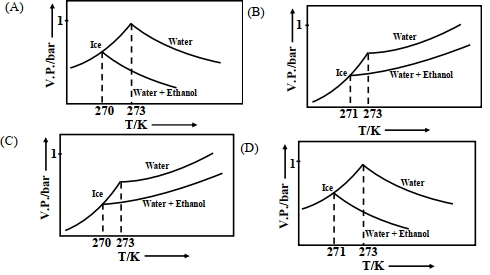
Pure water freezes at $273 \mathrm{~K}$ and $1$ bar. The addition of $34.5 \mathrm{~g}$ of ethanol to $500 \mathrm{~g}$ of water changes the freezing point of the solution. Use the freezing point depression constant of water as $2 \mathrm{~K} \mathrm{~kg} \mathrm{~mol}^{-1}$. The figures shown below represent plots of vapour pressure ($V.P$.) versus temperature ($T$). [molecular weight of ethanol is $46 \mathrm{~g} \mathrm{~mol}^{-1}$ ]

Among the following, the option representing change the freezing point is

(IMAGE)

Number of complexes with even number of electrons in $\mathrm{t}_{2 \mathrm{~g}}$ orbitals is -

${\left[\mathrm{Fe}\left(\mathrm{H}_2 \mathrm{O}\right)_6\right]^{2+},\left[\mathrm{Co}\left(\mathrm{H}_2 \mathrm{O}\right)_6\right]^{2+},\left[\mathrm{Co}\left(\mathrm{H}_2 \mathrm{O}\right)_6\right]^{3+},}$

${\left[\mathrm{Cu}\left(\mathrm{H}_2 \mathrm{O}\right)_6\right]^{2+},\left[\mathrm{Cr}\left(\mathrm{H}_2 \mathrm{O}\right)_6\right]^{2+}}$

In a solid lattice, the cation has left a lattice site and is located at interstitial position, the lattice defect is $.....:$