Question
The equation for the vibration of a string, fixed at both ends vibrating in its third harmonic, is given by$\text{y}=(0.4\text{cm})\sin\big[(0.314\text{cm}^{-1})\text{x}\big]\cos\big[(600\pi\text{s}^{-1})\text{t}\big]$
  1. What is the frequency of vibration?
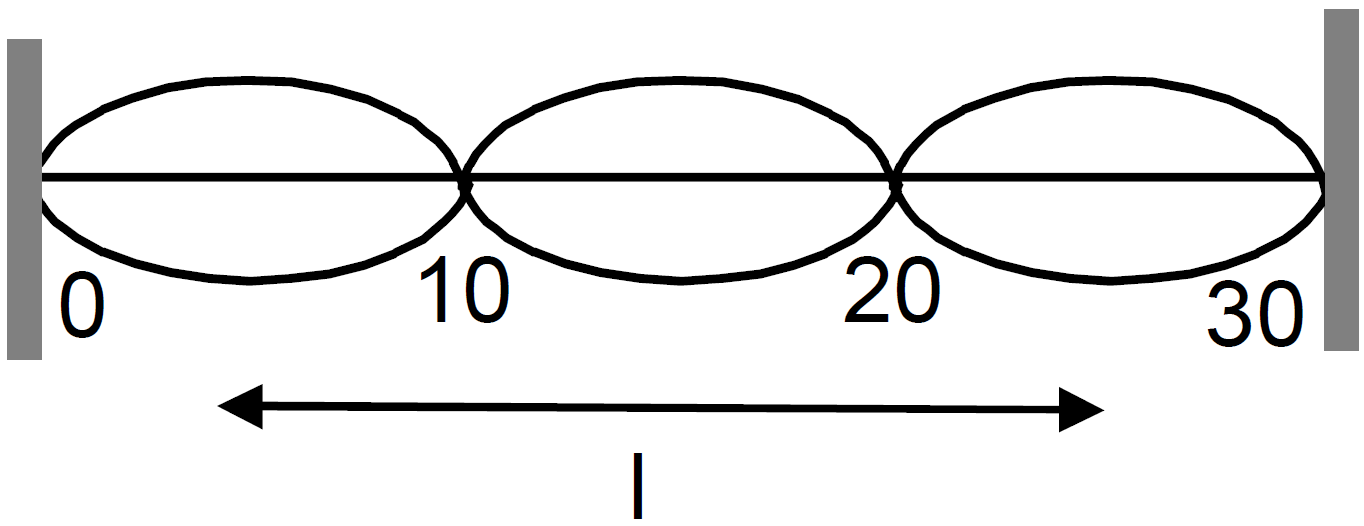
  2. What are the positions of the nodes?
  3. What is the length of the string?
  4. What is the wavelength and the speed of two travelling waves that can interfere to give this vibration ?
Answer

The stationary wave equation is given by$\text{y}(0.4\text{cm})\sin\big[(0.314\text{cm}^{-1})\text{x}\big]\cos\big[(600\pi\text{s}^{-1})\text{t}\big]$
  1. $\omega=600\pi\Rightarrow2\pi\text{f}=600\pi\Rightarrow\text{f}=300\text{Hz}$
Wavelength,, $\lambda=\frac{2\pi}{0.314}=\frac{(2\times3.14)}{0.314}=20\text{cm}$
  1. Therefore nodes are located at, $0,\ 10\text{cm},\ 20\text{cm},\ 30\text{cm}$
  2. Length of the string $=\frac{3\lambda}{2}=3\times\frac{20}{2}=30\text{cm}$
  3. $\text{y}=0.4\sin(0.314\text{x})\cos(600\pi\text{t})$
$\Rightarrow0.4\sin\Big\{\big(\frac{\pi}{10}\big)\text{x}\Big\}\cos(600\pi\text{t})$
since $\lambda$ and v are the wavelength and velocity of the waves that interfere to give this vibration $\lambda=20\text{cm}$
$\text{v}=\frac{\omega}{\text{k}}=6000\text{cm/sec}=60\text{m/s}$

Need a full question paper?

Generate a complete, print-ready paper with questions like this in minutes — across 16+ boards, with answer keys.

Start Generating Free

Similar questions

Explain principle, construction and working of optical fibre.
A capacitor of capacitance $100\mu\text{F}$ is connected to a battery of 20 volts for a long time and then disconnected from it. It is now connected across a long solenoid having 4000 turns per metre. It is found that the potential difference across the capacitor drops to 90% of its maximum value in 2.0 seconds. Estimate the average magnetic field produced at the centre of the solenofd during this period.
A particle is subjected to two simple harmonic motions of same time period in the same direction. The amplitude of the first motion is 3.0cm and that of the second is 4.0cm. Find the resultant amplitude if the phase difference between the motions is:
  1. 60°
  2. 90°
(I) Draw a ray diagram for the formation of image by a Cassegrain telescope.
(II) Why these types of telescopes are preferred over refracting type telescopes.
A parallel$-$plate capacitor having plate area $25\ cm^2$ and separation $1.00\ mm$ is connected to a battery of $6.0V.$ Calculate the charge flown through the battery. How much work has been done by the battery during the process?
Explain the terms: (i) Attenuation, (ii) Demodulation used in communication system.
The figure shows a series $\text{LCR}$ circuit with $L = 5.0 H, C = 80 \mu F, R = 40 W$ connected to a variable frequency $240V$ source. Calculate
  1. The angular frequency of the source which drives the circuit at resonance.
  2. The current at the resonating frequency.
  3. The rms potential drop across the capacitor at resonance.
When a photon is emitted by a hydrogen atom, the photon carries a momentum with it.
$(a)$ Calculate the momentum carries by the photon when a hydrogen atom emits light of wavelength $656.3\ nm.$
$(b)$ With what speed does the atom recoil during this transition? Take the mass of the hydrogen atom $= 1.67 \times 10^{-27}kg.$
$(c)$ Find the kinetic energy of recoil of the atom.
The half-life of a radioisotope is 10h. Find the total number of disintegrations in the tenth hour measured from a time when the activity was 1Ci.
Two long parallel wires are 8 cm apart. Currents of magnitudes $i$ and $3 i$ are flowing in them respectively in the same direction. Where the resultant magnetic field due to two will be zero?