MCQ
The equation $\vec{\phi}(x, t)=\vec{j} \sin \left(\frac{2 \pi}{\lambda} v t\right) \cos \left(\frac{2 \pi}{\lambda} x\right)$ represents
  • A
    Transverse progressive wave
  • B
    Longitudinal progressive wave
  • C
    Longitudinal stationary wave
  • Transverse stationary wave

Answer

Correct option: D.
Transverse stationary wave
(d)

Need a full question paper?

Generate a complete, print-ready paper with questions like this in minutes — across 16+ boards, with answer keys.

Start Generating Free

Similar questions

A thermo couple uses Bismuth and Tellurium as the dissimilar metals. The sensitivity of bismuth is $-72 \mu V /{ }^{\circ} C$ and that of the tellurium is $500 \mu V /{ }^{\circ} C$. If the difference between hot and cold junction is $100^{\circ} C$, then the maximum output will be
A force $(\vec{F})=3 \hat{i}+\hat{c j}+2 \hat{k}$ acting on a particle causes a displacement: $(\vec{s})=-4 \hat{i}+2 \hat{j}+3 \hat{k}$ in its own direction. If the work done is $6 J$, then the value of ' $c$ ' is
Pulling force making an angle $\theta$ to the horizontal is applied on a block of weight $W$ placed on a horizontal table. If the angle of friction is $\alpha$, then the magnitude of force required to move the body is equal to
Two Carnot engines $A$ and $B$ are operated in succession. The first one, $A$ receives heat from a source at $T_1=800 \mathrm{~K}$ and rejects to sink at $T_2 K$. The second engine $B$ receives heat rejected by the first engine and rejects to another sink at $T_3=300 \mathrm{~K}$. If the work outputs of two engines are equal, then the value of $T_2$ is
In a compound microscope magnification will be large, if the focal length of the eye piece is
The resistance of an incandescent lamp is
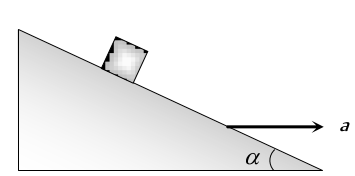
A block is kept on a frictionless inclined surface with angle of inclination ' $\alpha$ '. The incline is given an acceleration ' $a$ ' to keep the block stationary. Then $a$ is equal to

The hyper-metropia is a
A particle starts S.H.M. from the mean position. Its amplitude is $A$ and time period is $T$. At the time when its speed is half of the maximum speed, its displacement $y$ is
$540$ calories of heat convert $1$ cubic centimeter of water at $100^{\circ} \mathrm{C}$ into $1671$ cubic centimeter of steam at $100^{\circ} \mathrm{C}$ at a pressure of one atmosphere. Then the work done against the atmospheric pressure is nearly