MCQ
The equivalent conductance at infinite dilution $\left( {{ \wedge ^0}} \right)$ for electrolytes $BA$ and $CA$ are $140$ and $120\  S\  cm^2 eq^{-1}$. The equivalent conductance at infinite dilution for $BX$ is $198\  S \ cm^2 eq^{-1}$. The ${ \wedge ^0}$ (in $S\  cm^2 eq^{-1}$) of $CX$ is
  • $178$
  • B
    $198$
  • C
    $218$
  • D
    $130$

Answer

Correct option: A.
$178$
a
$\wedge_{\mathrm{CX}}^{o}=\wedge_{\mathrm{CA}}^{o}+\wedge_{\mathrm{BX}}^{o}-\wedge_{\mathrm{BA}}^{o}$

$=120+198-140$

$=178\, \mathrm{S}\, \mathrm{cm}^{2} \mathrm{eq}^{-1}$

Need a full question paper?

Generate a complete, print-ready paper with questions like this in minutes — across 16+ boards, with answer keys.

Start Generating Free

Similar questions

Which $\alpha$  amino acid can cross link peptide chains
$250\ mL$ of a waste solution obtained from the workshop of a goldsmith contains $0.1\, M AgNO _{3}$ and $0.1\, M$ AuCl. The solution was electrolyzed at $2\, V$ by passing a current of $1 \,A$ for $15$ minutes. The metal/metals electropositive will be

$\left(E_{A g^{+} / A g}^{0}=0.80\, V, E_{A n^{+} / A u}^{0}=1.69\, V\right)$

The $IUPAC$ symbols for the element with atomic number $119$ would be:
$A = 1s^2\, 2s^2\, 2p^4$         $B = 1s^2\, 2s^2\, 2p^5$       $C = 1s^2\, 2s^2\, 2p^6$
$A, B$ and $C$ are atoms/anion of same element. Then which one is correct (One of $A/B/C$ is neutral atom)
The amount of metal deposited at cathode on passing electric current of  $0.75$  $ampere$ in aqueous ferric sulphate solution for $30\, minutes$ , will be - ........... $\mathrm{g}$    (atomic wt. of  $Fe\, =\, 56$ )
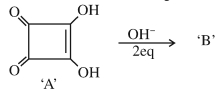
Correct statements for the given reaction are :

$A$. Compound ' $B$ ' is aromatic

$B$. The completion of above reaction is very slow

$C$. '$A$' shows tautomerism

$D$. The bond lengths $C - C$ in compound $B$ are found to be same

Choose the correct answer from the options given below :

$C{{H}_{3}}-C{{H}_{2}}-C{{H}_{2}}-C{{H}_{2}}-C{{H}_{3}}\xrightarrow{C{{H}_{2}}{{N}_{2}}/\Delta } Product$

Which of the following product $(s)$ is/are can be obtained in the above reaction.

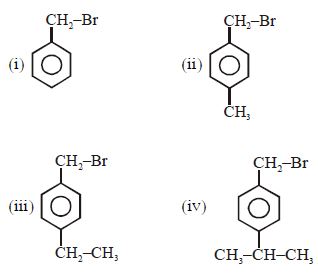
Arrange the following compounds in order of decreasing rate of hydrolysis for $S_N1$ reaction
The half life of a radioactive isotope is $4\, hours$. If the initial mass of isotope is $200\, gram$ then what will be the disintegrated amount of it after $16\, hours$  .......... $gm$
Which of the following has highest knocking