Question
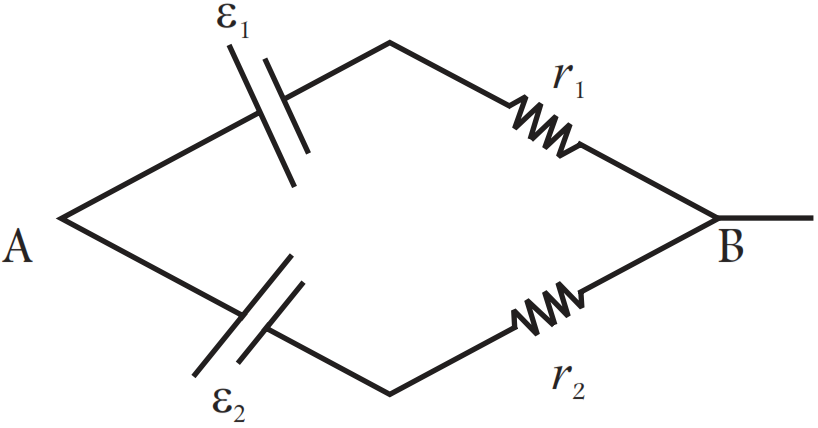
The equivalent resistance between the points P and Q in the network given here is equal to (given r =  )
)

|
(a) |
(b) 1 W |
(c) |
(d) 2 W |
The equivalent resistance between the points P and Q in the network given here is equal to (given r = )
|
(a) |
(b) 1 W |
(c) |
(d) 2 W |
(b) 1 W
Generate a complete, print-ready paper with questions like this in minutes — across 16+ boards, with answer keys.
A strip of copper and another of germanium are cooled from room temperature to 80 K. The resistance of
|
(a) Each of these increases |
|
(b) Each of these decreases |
|
(c) Copper strip increases and that of germanium decreases |
|
(d) Copper strip decreases and that of germanium increases |
A hollow insulated conducting sphere is given a positive charge of 10μC. What will be the electric field at the centre of the sphere if its radius is 2 meters
|
(a) Zero |
(b) 5 |
(c) 20 |
(d) 8 |
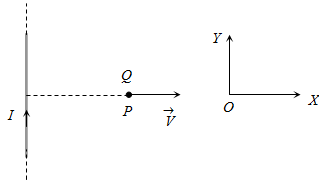
A very long straight wire carries a current I. At the instant when a charge +Q at point P has velocity  , as shown, the force on the charge is
|
(a) Opposite to OX |
(b) Along OX |
(c) Opposite to OY |
(d) Along OY |
When a charged particle enters a uniform magnetic field its kinetic energy
|
(a) Remains constant |
(b) Increases |
(c) Decreases |
(d) Becomes zero |
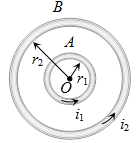
A and B are two concentric circular conductors of centre O and carrying currents  and
and  as shown in the adjacent figure. If ratio of their radii is 1 : 2 and ratio of the flux densities at O due to A and B is 1 : 3, then the value of
  is
is
|
(a) |
(b) |
(c) |
(d) |


