Question

The essential distinction between X-rays and  γ - rays is that

(a) γ-  rays have smaller wavelength than X-rays

(b) γ - rays emanate from nucleus while X-rays emanate from outer part of the atom

(c) γ- rays have greater ionizing power than X-rays

(d) γ- rays are more penetrating than X-rays

Answer

(b) γ - rays emanate from nucleus while X-rays emanate from outer part of the atom

Need a full question paper?

Generate a complete, print-ready paper with questions like this in minutes — across 16+ boards, with answer keys.

Start Generating Free

Similar questions

A convex lens of crown glass (n =1.525) will behave as a divergent lens if immersed in

(a) Water (n = 1.33)

(b) In a medium of n = 1.525

(c) Carbon disulphide n = 1.66

(d) It cannot act as a divergent lens

A frog can be levitated in a magnetic field produced by a current in a vertical solenoid placed below the frog. This is possible, because the body of the frog behaves as

A neon sign does not produce

(a) Line spectrum

(b) An emission spectrum

(c) An absorption spectrum

(d) Photons

The energy liberated on complete fission of 1 kg of  is (Assume 200 MeV energy is liberated on fission of 1 nucleus)

(a) 8.2  

(b) 8.2  

(c) 8.2  

(d) 8.2  

The black shapes in the figure are closed surfaces. The electric field lines are in red. For which case the net flux through the surfaces is non-zero?

In X-ray spectrum wavelength   of line   depends on atomic number Z as

(a)   

(b)  

(c)

(d)

The measurement of an unknown resistance R is to be carried out using Wheatstones bridge (see Fig. of NCERT Book). Two students perform an experiment in two ways. The first students takes R2 = 10Ω and R1 = 5Ω. The other student takes R2 = 1000Ω and R1 = 500Ω. In the standard arm, both take R3 = 5Ω.
Both find $\text{R}=\frac{\text{R}_2}{\text{R}_1}\text{R}_3=10\Omega$ within errors.

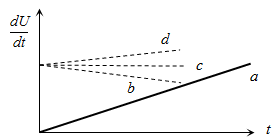
A constant current i is passed through a resistor.  Taking the temperature coefficient of resistance into account, indicate which of the plots shown in figure best represents the rate of production of thermal energy in the resistor

(a) a

(b) b

(c) c  

(d) d

Let $\overrightarrow{\text{A}}$ be a unit vector along the axis of rotation of a purely rotating body and $\overrightarrow{\text{B}}$ be a unit vector along the velocity of a particle P of the body away from the axis. The value of $\overrightarrow{\text{A}}.\overrightarrow{\text{B}}$ is:
  1. 1
  2. -1
  3. 0
  4. None of these.

The potential barrier, in the depletion layer, is due to

(a) Ions

(b) Holes

(c) Electrons

(d) Both (b) and (c)