MCQ
The factor by which the capacitance increases from its vacuum value when the dielectric is inserted fully between the plates of a capacitor, is called as:
- ADielectric.
- BDielectric constant of the substance.
- CPermittivity.
- DPermiability.
Generate a complete, print-ready paper with questions like this in minutes — across 16+ boards, with answer keys.
Certain radio-active substance reduces to 25% of its value in 16 days. Its half-life is
|
(a) 32 days |
(b) 8 days |
(c) 64 days |
(d) 28 days |
In the circuit, the reading of the ammeter is (assume internal resistance of the battery be zero)
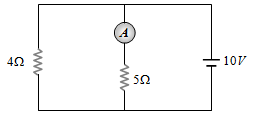
|
(a) |
(b) |
(c) |
(d) 2 A |
Two electric bulbs (60W and 100W respectively) are connected in series. The current passing through them is
|
(a) More in 100W bulb |
(b) More in 60W bulb |
(c) Same in both |
(d) None of these |
Which of the following statement is correct
|
(a) Liquids obey fully the ohm's law |
|
(b) Liquids obey partially the ohm's law |
|
(c) There is no relation between current and p.d. for liquids |
|
(d) None of the above |
A monochromatic beam of light passes from a denser medium into a rarer medium. As a result
|
(a) Its velocity increases |
(b) Its velocity decreases |
|
(c) Its frequency decreases |
(d) Its wavelength decreases |
A fuse wire with radius 1 mm blows at 1.5 amp. The radius of the fuse wire of the same material to blow at 3A will be
|
(a) |
(b) |
(c) |
(d) |
For production of characteristic  X-rays, the electron transition is
|
(a) n = 2 to n = 1 |
(b) n = 3 to n = 2 |
(c) n = 3 to n = 1 |
(d) n = 4 to n = 2 |
Which of the following pairs is an isobar
|
(a) |
(b) |
(c) |
(d) |


