MCQ
The feasible region corresponding to the linear constraints of a Linear Programming Problem is given belowImage
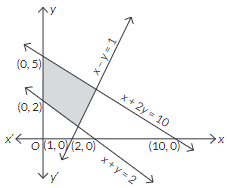
Which of the following is not a constraint to the given Linear Programming Problem?
  • A
    $x+y \geq 2$
  • B
    $x+2 y \leq 10$
  • C
    $x-y \geq 1$
  • D
    $x-y \leq 1$

Answer

We observe, $(0,0)$ does not satisfy the inequality
$x-y \geq 1$
So, the half plane represented by the above inequality will not contain origin therefore, it will not contain the shaded feasible region.

Need a full question paper?

Generate a complete, print-ready paper with questions like this in minutes — across 16+ boards, with answer keys.

Start Generating Free

Similar questions

If $\int_{\sin x}^1 {{t^2}f(t)\;dt = 1 - \sin x} $,  $x \in \left( {0,\frac{\pi }{2}} \right)$ then $f\;\left( {\frac{1}{{\sqrt 3 }}} \right)$ equal to
The element of second row and third column in the inverse of $\left[ {\begin{array}{*{20}{c}}1&2&1\\2&1&0\\{ - 1}&0&1\end{array}} \right]$ is
Let $[\lambda]$ be the greatest integer less than or equal to $\lambda$. The set of all values of $\lambda$ for which the system of linear equations $x+y+z=4,3 x+2 y+5 z=3$ $9 x+4 y+(28+[\lambda]) z=[\lambda]$ has a solution is:
Let $\vec{a}=6 \hat{i}+\hat{j}-\hat{k}$ and $\vec{b}=\hat{i}+\hat{j}$. If $\vec{c}$ is a is vector such that $|\vec{c}| \geq 6, \vec{a} \cdot \vec{c}=6|\vec{c}|,|\vec{c}-\vec{a}|=2 \sqrt{2}$ and the angle between $\vec{a} \times \vec{b}$ and $\vec{c}$ is $60^{\circ}$, then $|(\vec{a} \times \vec{b}) \times \vec{c}|$ is equal to:
$\int_0^1 {\frac{{{e^x}(x - 1)}}{{{{(x + 1)}^3}}}\,dx = } $
The value of $\int_0^1\left(2 x^3-3 x^2-x+1\right)^{\frac{1}{3}} d x$ is equal to:
Choose the correct answer from the given four option.Integrating factor of the differential equation $\frac{\text{d}\text{y}}{\text{d}\text{x}}+\text{y}\tan\text{x}-\sec\text{x}=0$ is:
Consider  $f (x) = | 1 - x | \,;\,1 \le x \le 2 $   and $g (x) = f (x) + b sin\,\frac{\pi }{2}\,x$, $1 \le x \le 2$  then which of the following is correct ?
$\int\limits^\infty_0\frac{1}{1+\text{e}^\text{x}}\text{dx}$ equals :
The region represented by the inequalities $\text{x}\geq6,\text{y}\geq2,2\text{x}+\text{y}\leq0,\text{x}\geq0,\text{y}\geq{0}$ is: