MCQ
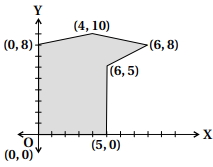
The feasible solution for a $LPP$ is shown in Figure Let $z=3 x-4 y$ be the objective function. Minimum of $Z$ occurs at $....$
  • A
    $(0,0)$
  • $(0,8)$
  • C
    $(5,0)$
  • D
    $(4,10)$

Answer

Correct option: B.
$(0,8)$
b
$(B) \,\,(0,8)$

Corner point

Objective function

$z=3 x-4 y$

$(0,0)$ $z=3(0)-4(0)=0$
$(5,0)$ $z=3(5)-4(0)=15$ (Maximum value)
$(6,5)$ $z=3(6)-4(5)=18-20=-2$
$(6,8)$ $z=3(6)-4(8)=-14$
$(4,10)$ $z=3(4)-4(10)=-28$
$(0,8)$ $z=3(0)-4(8)=-32($ minimum value )

Minimum value of the objective function is $-32$

$\therefore$ Minimum value exists at point $(0,8).$


Need a full question paper?

Generate a complete, print-ready paper with questions like this in minutes — across 16+ boards, with answer keys.

Start Generating Free

Similar questions

If the system of linear equation $x + 2ay + az = 0,$ $x + 3by + bz = 0,$ $x + 4cy + cz = 0$  has a non zero solution, then $a,b,c$
$\int_0^a {x{{(2ax - {x^2})}^{\frac{3}{2}}}\,dx = } $
The value of $\tan\Big(\cos^{-1}\frac{3}{5}+\tan^{-1}\frac{1}{4}\Big)=$
Let a curve $y=y(x)$ be given by the solution of the differential equation

$\cos \left(\frac{1}{2} \cos ^{-1}\left(e^{-x}\right)\right) d x=\sqrt{e^{2 x}-1} \,d y$

If it intersects $y$-axis at $y=-1$, and the intersection point of the curve with $x$-axis is $(\alpha, 0)$ the $\mathrm{e}^{\alpha}$ is equal to $.....$

Probability of speaking truth by $A$ is $\frac{4}{5}$ where as by $B$ is $\frac{3}{4}$. When they speak on a topic, then probability of contradiction:
$\overrightarrow{\text{r}} = \overrightarrow{\text{x}}{\hat{\text{i}}}+ \overrightarrow{\text{y}}{\hat{\text{j}}}$ is the equation of:
If $\text{P(A)}=\frac{7}{13},\text{P(B)}=\frac{9}{13}$ and $\text{P}(\text{A}\cap\text{B})=\frac{4}{13}.$ then, $\text{P}(\overline{\text{A}}|\text{B})=$
If $f(x) = \left\{ \begin{array}{l}\frac{{{x^4} - 16}}{{x - 2}},\,\,{\rm{when}}\,\,x \ne 2\\\,\,\,\,\,\,\,\,\,\,\,\,\,16,\,{\rm{when}}\,\,x = 2\end{array} \right.$, then
The equation $2\cos^{-1}\text{x}+\sin^{-1}\text{x}=\frac{11\pi}{6}$ has:
If $\vec p$ and $\vec q$ are unequal unit vectors such that $\left( {\vec p - \vec q} \right) . \left( {\left( {2\vec q + \vec p} \right) \times \left( {3\vec p - \vec q} \right)} \right) = \left| {\vec p + \vec q} \right|$ , then angle between $\vec p$ and $\vec q$ will be