MCQ
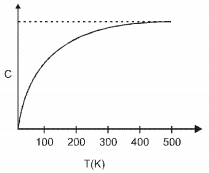
The figure below shows the variation of specific heat capacity $(C)$ of a solid as a function of temperature $(T)$. The temperature is increased continuously from $0$ to $500 \ K$ at a constant rate. Ignoring any volume change, the following statement$(s)$ is (are) correct to a reasonable approximation.$Image$

$(A)$ the rate at which heat is absorbed in the range $0-100 \ K$ varies linearly with temperature $T$.

$(B)$ heat absorbed in increasing the temperature from $0-100 \ K$ is less than the heat required for increasing the temperature from $400-500 \ K$.

$(C)$ there is no change in the rate of heat absorbtion in the range $400-500 \ K$.

$(D)$ the rate of heat absorption increases in the range $200-300 \ K$.
  • $( A , B , C , D )$
  • B
    $(A,C)$
  • C
    $(A,B,D)$
  • D
    $(A,C,D)$

Answer

Correct option: A.
$( A , B , C , D )$
a
$q=m C T $

$\frac{d q}{d t}=m c \frac{d T}{d t}$

$R =$ rate of absortion of heat $=\frac{ dq }{ dt } \propto C$

$(i)$ in $0-100 k$

$C$ increases, so $R$ increases but not linearly

$(ii)$ $\Delta q=m C \Delta T$ as $C$ is more in ( $400 k-500 k)$ then $(0-100 k)$ so heat is increasing.

$(iii)$ $C$ remains constant so there no change in $R$ from ( $400 k-500 k$ )

$(iv)$ $C$ is increases so $R$ is increases in range $(200 k-300 k)$

Need a full question paper?

Generate a complete, print-ready paper with questions like this in minutes — across 16+ boards, with answer keys.

Start Generating Free

Similar questions

Two spheres of same size one of mass $2\ kg$ and another of mass $4\ kg$ are dropped simultaneously from the top of Qutab Minar $($height $= 72m)$. When they are $1m$ above the ground, the two spheres have the same:
A ball is bouncing elastically with a speed $1\ m/s$ between walls of a railway compartment of size $10m$ in a direction perpendicular to walls. The train is moving at a constant velocity of $10\ m/s $ parallel to the direction of motion of the ball. As seen from the ground,
A body is moving with velocity $1\ m/ s$ at a height $3m$ from the ground. What will be its speed at height $2m$ from the ground?
A large drop of oil (density $0.8\,g / cm ^3$ and viscosity $\eta_0$) floats up through a column of another liquid (density $1.2\,g / cm ^3$ and viscosity $\eta_L$ ). Assuming that the two liquids do not mix, the velocity with which the oil drop rises will depend on.
In changing the state of thermodynamics from $A$ to $B$ state, the heat required is $Q$ and the work done by the system is $W.$ The change in its internal energy is
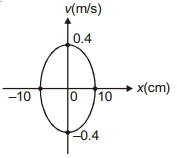
The plot of velocity $(v)$ versus displacement $(x)$ of a particle executing simple harmonic motion is shown in figure. The time period of oscillation of particle is .........
If $I_1, I_2$ and $I_3$ are moments of inertia of solid sphere, hollow sphere and a ring of same mass and radius about geometrical axis, which of the following statements hold good ?
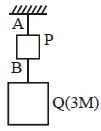
Wires $A$ and $B$ are connected with blocks $P$ and $Q$ as shown. The ratio of lengths, radii and Young's modulus of wires $A$ and $B$ are $r, 2r$ and $3r$ respectively ($r$ is a constant). Find the mass of block $P$ if ratio of increase in their corresponding lengths is $1/6r^2$. The mass of block $Q$ is $3M$.
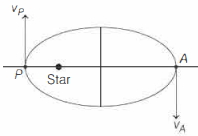
A planet orbits in an elliptical path of eccentricity $e$ around a massive star considered fixed at one of the foci. The point in space, where it is closest to the star is denoted by $P$ and the point, where it is farthest is denoted by $A$. Let $v_P$ and $v_A$ be the respective speeds at $P$ and $A$, then
Mark the correct options: