MCQ
The figure formed by the lines $\text{ax} \pm \text{by} \pm \text{c} = 0 $ is:
- Aa rectangle.
- Ba square.
- Ca rhombus.
- DNone of these.
The figure formed by the lines $\text{ax} \pm \text{by} \pm \text{c} = 0 $ is:
Solution:
The given lines can be written separately in the following manner:
ax + by + c = 0 ...(1)
ax + by - c = 0 ...(2)
ax - by - c = 0 ...(3)
ax - by - c = 0 ...(4)
Graph of the given lines is given below:
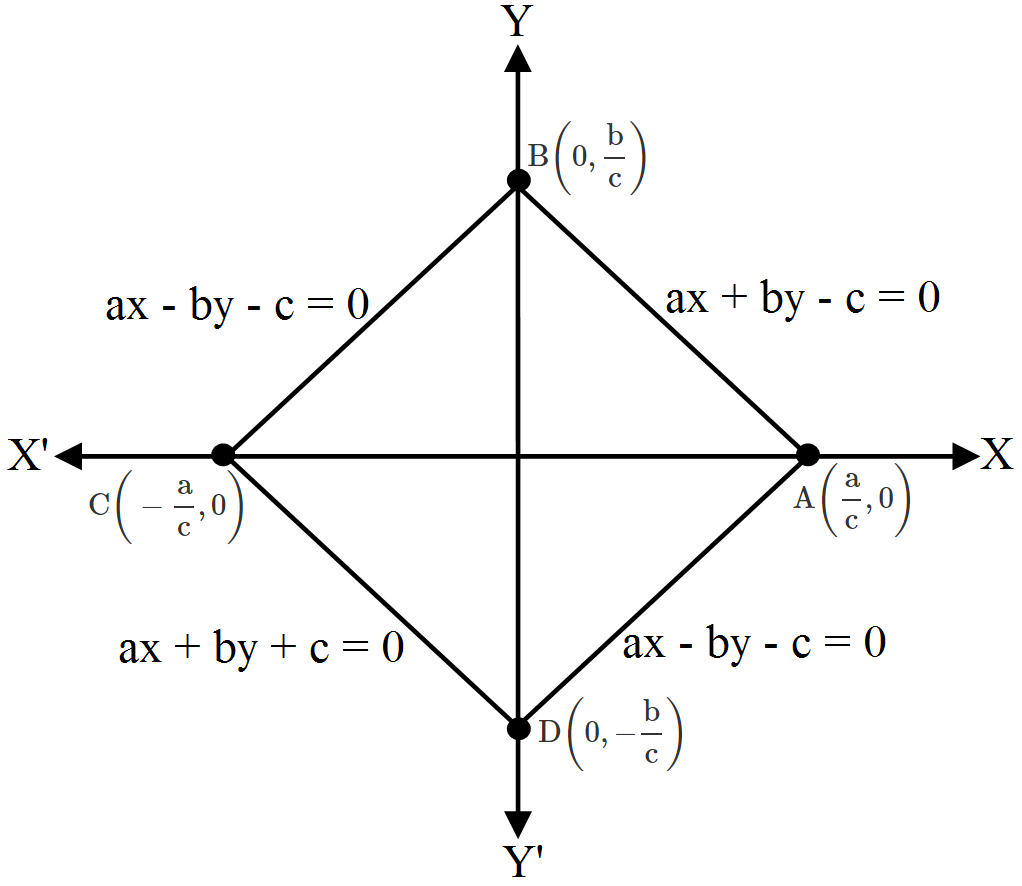
Clearly, $\text{AB}=\text{BC}=\text{CD}=\text{DA}=\sqrt{\frac{\text{a}^2}{\text{c}^2}+\frac{\text{b}^2}{\text{c}^2}}=\frac{\sqrt{\text{a}^2+\text{b}^2}}{|\text{c}|}$
Thus, the region formed by the given lines is ABCD, which is a rhombus.
Generate a complete, print-ready paper with questions like this in minutes — across 16+ boards, with answer keys.
If the points A (1, 2), B (2, 4) and C (3, a) are collinear, what is the length BC?
A die is thrown then find the probability of getting an odd number.
Six boys and six girls sit in a row at random. The probability that the boys and girls sit alternatively is:
A and B are two events such that P (A) = 0.25 and P (B) = 0.50. The probability of both happening together is 0.14. The probability of both A and B not happening is
The equation of a circle with origin as centre and passing through the vertices of an equilateral triangle whose median is of length 3a is:
[Hint: Centroid of the triangle coincides with the centre of the circle and the radius of the circle is $\frac{2}{3}$ of the length of the mediam]