Question
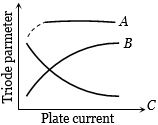
The figure represents variation of triode parameter ($\pi$ or $r_p$ or gm) with the plate current. The correct variation of $\mu$and rp are given, respectively by the curves
Answer

(c)$r_p$ varies with $i_p$ according to relation ${r_p} \propto i_p^{ - 1/3}$ i.e. when $i_p$ increases, $r_p$ decreases, hence graph $C $ represents the variation of $r_p$.
$\mu$ doesn't depends upon $i_p$, hence graph $A$  is correct.

Need a full question paper?

Generate a complete, print-ready paper with questions like this in minutes — across 16+ boards, with answer keys.
Start Generating Free

Similar questions

$M{L^{ - 1}}{T^{ - 2}}$ represents
If in a nuclear fusion process the masses of the fusing nuclei be ${m_1}$ and ${m_2}$ and the mass of the resultant nucleus be ${m_3}$, then
Velocity of an object in rectilinear motion is given as function of time by $v = t -t^3$, where $v$ is in $m/s$ and $t$ is in seconds. Its average velocity over the time interval from $t = 0\ s$ to $t = 2\ s$ is........$m/s$
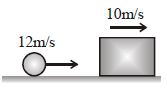
A light particle moving horizontally with a speed of $12\  m/s$ strikes a very heavy block moving in the same direction at $10\  m/s$. The collision is one-dimensional and elastic. After the collision, the particle will
A beam of light consisting of two wavelengths $650\, nm$ and $520\, nm$ is used to illuminate the slit of a Young’s double slit experiment. Then the order of the bright fringe of the longer wavelength that coincide with a bright fringe of the shorter wavelength at the least distance from the central maximum is
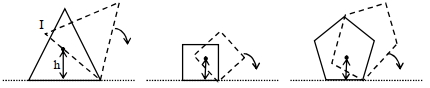
Consider regular polygons with number of sides $\mathrm{n}=3,4,5, \ldots$. as shown in the figure. The center of mass of all the polygons is at height $\mathrm{h}$ from the ground. They roll on a horizontal surface about the leading vertex without slipping and sliding as depicted. The maximum increase in height of the locus of the center of mass for each polygon is $\Delta$. Then $\Delta$ depends on $n$ and $h$ as
If a man at the equator would weigh $(3/5)^{th}$ of his weight, the angular speed of the earth is
A square shaped wire loop of mass $m$, resistance $R$ and side $a$ moving speed $v_{0}$, parallel to the $X$-axis, enters a region of uniform magnetic field $B$, which is perpendicular to the plane of the loop. The speed of the loop changes with distance $x(x < a)$ in the field, as
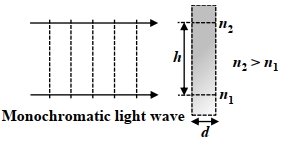
A monochromatic light wave is incident normally on a glass slab of thickness $d$, as shown in the figure. The refractive index of the slab increases linearly from $n_1$ to $n_2$ over the height $h$. Which of the following statement($s$) is (are) true about the light wave emerging out of the slab?

(image)

($A$) It will deflect up by an angle $\tan ^{-1}\left[\frac{\left(n_2^2-n_1^2\right) d}{2 h}\right]$

($B$) It will deflect up by an angle $\tan ^{-1}\left[\frac{\left(n_2-n_1\right) d}{h}\right]$

($C$) It will not deflect.

($D$) The deflection angle depends only on $\left(n_2-n_1\right)$ and not on the individual values of $n_1$ and $n_2$.
The period of oscillations of a magnetic needle in a magnetic field is $1.0 \,sec$. If the length of the needle is halved by cutting it, the time period will be.....$sec$