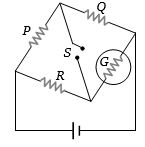
The figure shows a circuit diagram of a ‘Wheatstone Bridge’ to measure the resistance $G$ of the galvanometer. The relation $\frac{P}{Q} = \frac{R}{G}$ will be satisfied only when
Easy


Download our appand get started for free
Experience the future of education. Simply download our apps or reach out to us for more information. Let's shape the future of learning together!No signup needed.*
Similar Questions
- 1The terminal potential difference of a cell when short-circuited is ($E$ = $E.M.F.$ of the cell)View Solution
- 2A resistance of $2 \Omega$ is comnected across one gap of a metre-bridge (the length of the wire is $100 \mathrm{~cm}$ ) and an unknown resistance, greater than $2 \Omega$, is connected across the other gap. When these resistance are interchanged, the balance point shifts by $20 \mathrm{~cm}$. Neglecting any corrections, the unknown resistance isView Solution
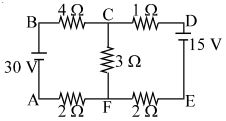
- 3View SolutionThe figure shows a network of five resistances and two batteries Which of the batteries is getting charged.
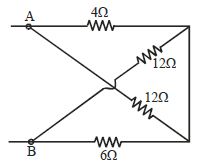
- 4In given Network the equivalent resistance between $A$ and $B$ is .............. $\Omega$View Solution
- 5A wire of length $5\,m$ and radius $1\,mm$ has a resistance of $1\, ohm$. What length of the wire of the same material at the same temperature and of radius $2\,mm$ will also have a resistance of $1\, ohm$ .............. $m$View Solution
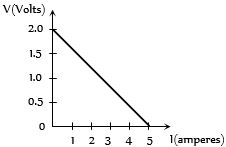
- 6For a cell, the graph between the potential difference $(V) $ across the terminals of the cell and the current $(I)$ drawn from the cell is shown in the figure. The $e.m.f.$ and the internal resistance of the cell areView Solution
- 7In the figure shown, the current in the $10\, V$ battery is close toView Solution
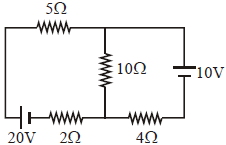
- 8The value of internal resistance of an ideal cell is $\Omega$View Solution
- 9When two identical batteries of internal resistance $1 \Omega$ each are connected in series across a resistor $\mathrm{R}$, the rate of heat produced in $R$ is $J_1$. When the same batteries are connected in parallel across $R$, the rate is $\mathrm{J}_2$. If $\mathrm{J}_1=2.25 \mathrm{~J}_2$ then the value of $\mathrm{R}$ in $\Omega$ isView Solution
- 10The resistances of the four arms $P, Q, R$ and $S$ in a Wheatstone's bridge are $10\,ohm$, $30\,ohm$, $30\,ohm$ and $90\,ohm$, respectively. The e.m.f. and internal resistance of the cell are $7\,volt$ and $5\,ohm$ respectively. If the galvanometer resistance is $50\,ohm$, the current drawn from the cell will be ............... $A$View Solution