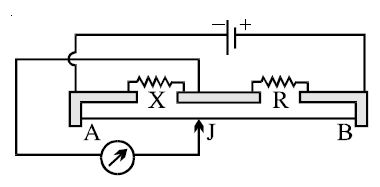
The figure shows a meter-bridge circuit, with $AB = 100\, cm$,$ X = 12\,\Omega$ and $R = 18\,\Omega$ , and the jockey $J$ in the position of balance. If $R$ is now made $8\,\Omega$ , through what distance will $J$ have to be moved to obtain balance? .............. $cm$
Diffcult
Download our app for free and get started
The balancing condition for meter bridge is,
$\frac{X}{R}=\frac{l_{1}}{100-l_{1}}$
$X=R\left(\frac{l_{1}}{100-l_{1}}\right)$
$12=18\left(\frac{l_{1}}{100-l_{1}}\right)$
$1200=30 l_{1}$
$l_{1}=40 \mathrm{cm}$
When $R=8$ ohm,
$12=8\left(\frac{l_{2}}{100-l_{2}}\right)$
$1200=20 l_{2}$
$l_{2}=60 \mathrm{cm}$
Hence, distance through $J$ is shifted is
$l=l_{2}-l_{1}=20 \mathrm{cm}$

Download our appand get started for free
Experience the future of education. Simply download our apps or reach out to us for more information. Let's shape the future of learning together!No signup needed.*
Similar Questions
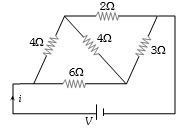
- 1For the network shown in the figure the value of the current $i$ isView Solution
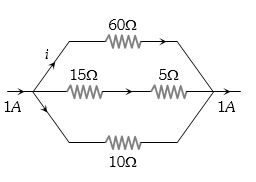
- 2The magnitude of $i$ in ampere unit isView Solution
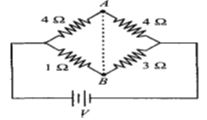
- 3In the circuit shown, if a conducting wire is connected between points $A$ and $B,$ the current in this wire willView Solution
- 4Wheatstone bridge principle is used to measure the specific resistance $\left(S_1\right)$ of given wire, having length $L$, radius $r$. If $X$ is the resistance of wire, then specific resistance is: $S_1=X\left(\frac{\pi r^2}{L}\right)$. If the length of the wire gets doubled then the value of specific resistance will be :View Solution
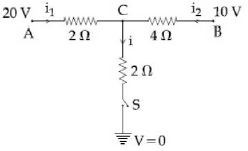
- 5When the switch $S$, in the circuit shown, is closed, then the value of current $i$ will be ................. $A$View Solution
- 6This question contains statement$-1$ and statement$-2$. Of the four choices given after the statements, choose the one that best describes the two statements.View Solution
statement$-1$ : The temperature dependence of resistance is usually given as $R=R_{0}(1+\alpha \Delta t)$. The resistance of a wire changes from $100\; \Omega$ to $150\; \Omega$ when its temperature is increased from $27^{\circ} C$ to $227^{\circ} C$. This implies that $\alpha=2.5$ $\times 10^{-3} /{ }^{\circ} C$
statement$-2\;: R=R_{0}(1+\alpha \Delta t)$ is valid only when the change in the temperature $\Delta T$ is small and $\Delta R=\left(R-R_{0}\right) < < R_{0}$
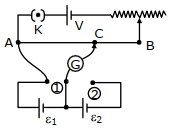
- 7In the given potentiometer circuit arrangement, the balancing length ${AC}$ is measured to be $250$ ${cm}$. When the galvanometer connection is shifted from point $(1)$ to point $(2)$ in the given diagram, the balancing length becomes $400\, {cm}$. The ratio of the emf of two cells, $\frac{\varepsilon_{1}}{\varepsilon_{2}}$ is -View Solution
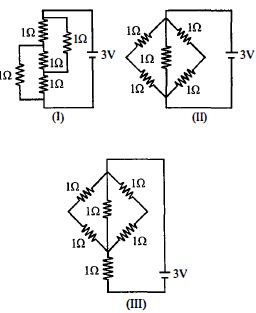
- 8The figure shows three circuits $I, II$ and $III$ which are connected to a $3\,V$ battery. If the powers dissipated by the configurations $I, II$ and $III$ are $P_1 , P_2$ and $P_3$ respectively, thenView Solution
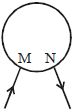
- 9A uniform wire of resistance $20\,ohm$ having resistance $1\Omega /m$ is bent in the adjoining form of a circle as shown in the figure. If the equivalent resistance between $M$ and $N$ is $1.8 \,\Omega $, then the length of the shorter section is ................ $m$View Solution
- 10A uniform wire of resistance $R$ is uniformly compressed along its length, until its radius becomes $n$ times the original radius. Now resistance of the wire becomesView Solution