Question
The final image is formed in a compound microscope will be :

Answer

(B) - virtual and inverted

Need a full question paper?

Generate a complete, print-ready paper with questions like this in minutes — across 16+ boards, with answer keys.
Start Generating Free

Similar questions

The electric field at a point on equatorial line of a dipole and direction of the dipole moment:
A proton enters in a straight line in a uniform magnetic field along the field direction. How will its path and velocity change?
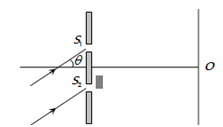
A monochromatic beam of light falls on $\text{YDSE}$ apparatus at some angle $($say $q)$ as shown in figure. A thin sheet of glass is inserted in front of the lower slit $S_2$. The central bright fringe $($path difference $= 0)$ will be obtained
Television signals on earth cannot be received at distances greater than 100 km from the transmission station. The reason behind this is that(a) The receiver antenna is unable to detect the signal at a distance greater than 100 km(b) The TV programme consists of both audio and video signals(c) The TV signals are less powerful than radio signals(d) The surface of earth is curved like a sphere


The radius of the Bohr orbit in the ground state of hydrogen atom is $0.5\ \mathring A .$ The radius of the orbit of the electron in the third excited state of $He^+$ will be
Ionization potential of hydrogen atom is 13.6 V.
Hydrogen atoms in the ground state are excited by monochromatic radiation of photon energy 12.1 eV. The spectral lines emitted by hydrogen atoms according to Bohr's theory will be(a) One   (b) Two(c) Three(d) Four
       
The charge is negative, then the electric lines of forces are:
Red light is used as danger signal because it is:
The value of torque ($\vec{\tau}$) experienced by current loop of magnetic moment $(\vec{m})$ placed in magnetic field ($\vec{B}$) is :
Two electric bulbs whose resistances are in the ratio of 1 : 2 are connected in series. The powers dissipated in them have the ratio(a) 1 : 2(b) 2 : 1(c) 1 : 1(d) 1 : 4