MCQ
The first cellular form of life could have originated
  • $2000$ million years back
  • B
    $11000$ million years back
  • C
    $1500$ million years back
  • D
    $500$ million years back

Answer

Correct option: A.
$2000$ million years back
a
$2000$ million years.

Experimental Evidences of Chemical Evolution

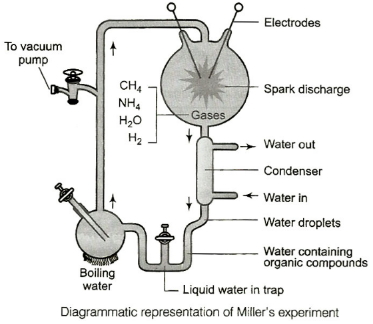
Experi ik mentally chemical theory of evolution performed by SL Miller and HC Uray in $1953 .$

He created electric discharge in a closed flask containing $CH _{4}, H _{2}, N H _{3}$ and water vapour at $800\, C .$ He observed formation of amino acids. In similar experiments other the observed, formation of sugar, nitrogen bases, pigments and fats

The first non-cellular forms of life could have originated-$3$ billion years back. The first cellular form of life did not possibly originated till about $2$ billion years ago because the conditions were non-biogenic at that time. This version of biogenesis, $i.e.,$ the first form of life arose slowly through evolutionary forces from non-living molecule was accepted by majority
Need a full question paper?

Generate a complete, print-ready paper with questions like this in minutes — across 16+ boards, with answer keys.

Start Generating Free

Similar questions

Assertion: Nephridia are the tubular excretory structures of earthworms and other annelids.
Reason: Nephridia help to remove nitrogenous wastes and maintain a fluid and ionic balance.
Select the incorrect statements
A. Tetrad formation is seen during leptotene
B. During Anaphase, the centromere split and chromatids separate.
C. Terminalization takes place during Pachytene.
D. Nucleolus, Golgi complex and ER are reformed during Telophase.
E. Crossing over takes place between non sister chromatids of homologous
Choose the correct answer from the option given below:
Skeletal system consists of a framework of bones and a few cartilages. Bone and cartilage are specialised connective tissues. From given statement which of the following are correct for human skeletal system ?
(i) In human beings, this system is made up of 206 bones and a few cartilages.
(ii) Axial skeleton comprises 80 bones distributed along the main axis of the body.
(iii) The skull, vertebral column, sternum and ribs constitute axial skeleton.
(iv) Cranial bones are 8 in number. The facial region is made up of 14 skeletal elements which form the front part of the skull.
(v) First vertebra is the atlas and it articulates with the occipital condyles and human skull is bicephalic.
(vi) The number of cervical vertebrae are seven in almost all mammals including human beings.
(vii) Ribs has two articulation surfaces on its dorsal end and is hence called dicondylic.
(viii) Last 3 pairs of ribs are not connected ventrally and are therefore, called floating ribs.
If a person has lost his memory in an accident, the following part of the brain have got injured
Presence of which of the following conditions in urine are indicative of Diabetes Mellitus$?$
Failure of insulin production results in
Animals with metameric segmentation, bilateral symmetry and closed circulatory system belong to phylum
The adrenal medulla secretes two hormones called adrenaline or ...$A$... and noradrenaline or ...$B$.... These are commonly called as ...$C$... Adrenaline and noradrenaline are rapidly secreted in response to stress of any kind and during ...$D$.. situations and are called emergency hormones or hormones of fight or flight.

Identify $A \;to \;D$ and choose the correct option

Spongilla is....
In humans, schizont stage of Plasmodium is found in