Question
The first shell may contain up to 2 electrons, the second shell up to 8, the third shell up to 18, and the fourth shell up to 32. Explain this arrangement in terms of quantum numbers.

Answer

For the fust shell $\text{n}=1,\text{l}=0,\text{m}_\text{l}=0,\text{m}_\text{s}=+\frac{1}{2}$ and $-\frac{1}{2}.$ It can have 2 electrons both with opposite spins.
  1. For $\text{n}=2,$
$\text{l}=0,\text{m}_\text{l}=0,\text{m}_\text{s}=+\frac{1}{2},-\frac{1}{2},$

$\text{l}=1,\text{m}_\text{l}=1,0+1,\text{m}_\text{s}=+\frac{1}{2},-\frac{1}{2}.$

Therefore, a total of 2 + 6 = 8 electrons are present.
  1. For $\text{n}=3,$ when
$\text{l}=0,\text{m}_\text{l}=0,\text{m}_\text{s}=+\frac{1}{2},-\frac{1}{2}$

$\text{l}=1,\text{m}_\text{l}=-1,0+1,\text{m}_\text{s}=\frac{1}{2},-\frac{1}{2}$

$\text{l}=2,\text{m}_\text{l}=-2,-1,0,+1,+2,,\text{m}_\text{s}$

$=+\frac{1}{2},-\frac{1}{2}$

Therefore, a total of 2 + 6 + 10 = 18 electlons aie present.
  1. For $\text{n}=4,$ when
$\text{l}=0,\text{m}_\text{l}=0,\text{m}_\text{s}=+\frac{1}{2},-\frac{1}{2}$

$\text{l}=1,\text{m}_\text{l}=-1,0+1,\text{m}_\text{s}=+\frac{1}{2},-\frac{1}{2}$

$\text{l}=3,\text{m}_\text{l}=-2,-1,0+1,+2,\text{m}_\text{s}=+\frac{1}{2},-\frac{1}{2}$

$\text{l}=3,\text{m}_\text{l}=-3,-2,-1,0,+1,+2,+3,\text{m}_\text{s}$

$=+\frac{1}{2},-\frac{1}{2}$

Therefore, a total of 2 + 6 + 10 + 14 = 32 electrons are present.

Need a full question paper?

Generate a complete, print-ready paper with questions like this in minutes — across 16+ boards, with answer keys.
Start Generating Free

Similar questions

On the basis of Le Chatelier principle explain how temperature and pressure can be adjusted to increase the yield of ammonia in the following reaction.
$\text{N}_2\text{(g)}+\text{3H}_2\text{(g)}\rightleftharpoons\text{2NH}_3\text{(g)} \ \ \ \ \ \ \ \Delta\text{H}= – 92.38\text{kJ mol}^{–1}$
What will be the effect of addition of argon to the above reaction mixture at constant volume?
On the basis of VSEPR theory, predict the shapes of the following
1. $NH _2^{-}$
2. $O _3$
0.5 mole each of $\mathrm{H}_2 \mathrm{~S}$ and $\mathrm{SO}_2$ mixed together in a reaction Flask, react according to equation:
$2 \mathrm{H}_2 \mathrm{~S}+\mathrm{SO}_2 \rightarrow 2 \mathrm{H}_2+3 \mathrm{~S}$
Calculate the number of moles of 'S' formed.
  1. $NH_3$ has more dipole moment than $NF_3$ although $\text{N}-\text{F}$ bond is more polar than $\text{N}-\text{H}$ bond, why?
  2. $H_2O$ is liquid while $H_2S$ is gas, why?
How can you explain higher stability of $\mathrm{BCl}_3$ as compared to $\mathrm{TICl}_3$ ?
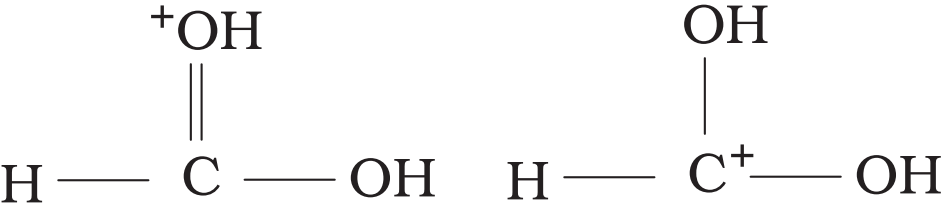
What is the relationship between the members of following pairs of structures? Are they structural or geometrical isomers or resonance contributors?
Find out the value of $\text{K}_{\text{c}}$ for each of the following equilibria from the value of $\text{K}_{\text{p}}$:
$2\text{CaCO}_3\text{ (S)}\rightleftharpoons\text{CaO(S) + CO}_2\text{ (g)};\text{ k}_{\text{p}}=167\text{ at }1073\text{K}$
The alkali and alkaline earth metals characterized by their large atomic sizes, lower ionisation enthalpies, invariable +1 oxidaton state and solubility of their oxo salts. In the light of these features describe the nature of oxides, halides and oxo salts.
Among the elements of second period Li to Ne, pick out element:
  1. With the highest first ionisation energy.
  2. With highest electronegativity.
  3. With largest atomic radius.
  4. That is most reactive non-metal.
  5. That is most reactive metal.
  6. With valency equal to 4.
i. Write the resonance structures for $\mathrm{CO}_2$.
ii. Draw Lewis structure of $\mathrm{H}_2 \mathrm{SO}_4$.
iii. Why $\mathrm{KHF}_2$ exist but $\mathrm{KHCl}_2$ does not?