MCQ
The following are synthetic polymers except:
  • A
    Teflon
  • B
    Terylene
  • C
    Nylon
  • Proteins

Answer

Correct option: D.
Proteins
Proteins are natural polymers. Rest of them are synthetic polymers.

Need a full question paper?

Generate a complete, print-ready paper with questions like this in minutes — across 16+ boards, with answer keys.
Start Generating Free

Similar questions

For a reaction of order $\mathrm{n}$, the unit of the rate constant is :
Reason of lanthanoid contraction is
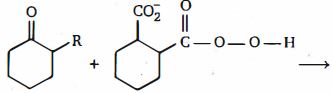
Above reaction is a Baeyer Villiger rearrangement of an asymmetric ketone with  magnesium mono peroxo pthalate hexahydrate (in the drawing, $Mg^{+2}$ is  omitted for clearity) Identify major product.
The time for half life period of a certain reaction $A \rightarrow$ Products is $1$ hour. When the initial concentration of the reactant $'A',$ is $2.0\, mol\, L^{-1},$ ....... $hr$ does it take for its concentration to come from $0.50$ to $0.25\, mol\, L^{-1}$ if it is a zero order reaction ?
Which alkene is formed from the following reaction

$C{H_3}C{H_2}C{H_2}CH = PP{h_3} + 2 - $  Butanone

In the reaction sequence

$CHC{l_3}\xrightarrow{{Air/hv}}x\xrightarrow[{Excess}]{{{C_6}{H_6}\,/\,Anhy\,AlC{l_3}}}y$ , $y$ will be
Carbogen is
Benzene can be obtained by heating either benzoic acid with X or phenol with Y. X and Y respectively are:
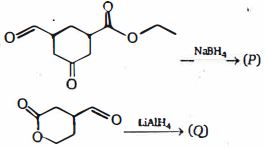
Sum of number of $1^o$ alcoholic groups in product $(P)$ and $(Q)$ is
What will be the major product of each of the two reaction shown below ?

$1.$ $\begin{array}{*{20}{c}}
  {C{H_3}C{H_2}CHC{H_3}{\mkern 1mu} } \\ 
  {{\mkern 1mu} \,\,\,\,\,\,|} \\ 
  {\,\,\,\,\,\,\,\,\,\,\,\,\,\,\,\,\,\,\,\,\,\,\,\,\,\,\,\,\,\,\,\,{\,^ + }N{{(C{H_3})}_3}^ - OH} 
\end{array}$ $\xrightarrow{{heat}}$ $\mathop {C{H_3}CH = CHC{H_3}}\limits_X $ $+$ $\mathop {C{H_3}C{H_2}CH = C{H_2}}\limits_Y $ 

$2.$  $\begin{array}{*{20}{c}}
  {C{H_3}C{H_2}CHC{H_3}} \\ 
  {\,\,\,\,\,\,\,|} \\ 
  {\,\,\,\,\,\,\,Br} 
\end{array}$ $\xrightarrow{{heat}}$ $\mathop {C{H_3}CH = CHC{H_3}}\limits_X $ $+$ $\mathop {C{H_3}C{H_2}CH = C{H_2}}\limits_Y $