MCQ
The following data are obtained when dinitrogen and dioxygen react together to form different compounds

Mass of dinitrogen Mass of dioxygen
$14\, g$ $16\, g$
$14\, g$ $32\, g$
$28\, g$ $32\, g$
$28\, g$ $80\, g$

Which law of chemical combination is obeyed by the above experimental data ?

  • A
    Law of conservation of mass
  • B
    Law of definite proportions
  • Law of multiple proportions
  • D
    Avogadro's Law

Answer

Correct option: C.
Law of multiple proportions
c
Fixing the mass of dinitrogen as $14\,g,$ the mass of dioxygen combined varies as $16,32 .$ The reactants are in the ration $1: 1$ and $1: 2,$ respectively and forms different compounds.

Similarly other ratio of the reactants are $2: 1,2: 5$ in case of fixing mass of $N_{2}$ as $28 \mathrm{g}$ and varing mass of $O_{2}$ as $32 \mathrm{g}$ and $80 \mathrm{g}$ respectively.

Here two elements combine to form more than one compound and the masses of one element that combine with a fixed mass of the other element, are in the ratio of small whole numbers. Thus they follow the law of multiple proportions. thus option $C$ is correct.

Need a full question paper?

Generate a complete, print-ready paper with questions like this in minutes — across 16+ boards, with answer keys.

Start Generating Free

Similar questions

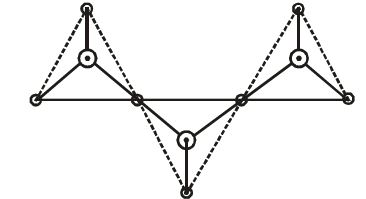
Formula of the following silicate anion structure is, where $ \bullet $ $ -'Si'$ atom,  $o-'O'$ atom
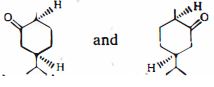
The two compounds shown below are
A $0.004\, M$ solution of $N{a_2}S{O_4}$ is isotonic with a $0.010 \,M$ solution of glucose at same temperature. The apparent degree of disociation of $N{a_2}S{O_4}$ is.....$\%$
The theory that can completely/properly explain the nature of bonding in $[Ni(CO)_4]$ is
The boiling point of benzene is $353.23\,\, K$. When $1.80\,gm$ of a nonvolatile solute was dissolved in $90\,gm$ of benzene, the boiling point is raised to $354.11\,K$. the molar mass of the solute is ........ $g\,mo{l^{ - 1}}$ . $[{K_b}$ for benzene $= 2.53 \,K\,mol^{-1}$]
In the reaction with $HCl,$ an alkene reacts in accordance with the Markovnikov's rule to give a product $1-$chloro${-1}$ methylcyclohexane. The possible alkene is
$CaC{O_{3(s)}}$ $\rightleftharpoons$ $Ca{O_{(s)}} + C{O_{2(g)}}$ which of the following expression is correct
When $C{H_3}COC{H_3}$ reacts with $C{l_2}$ and $NaOH,$ which of the following is formed
Preparation of alkyl halides in laboratory is least preferred by
$50 \mathrm{~mL}$ of $0.2$ molal urea solution (density $=1.012 \mathrm{~g} \mathrm{~mL}^{-1}$ at $300 \mathrm{~K}$ ) is mixed with $250 \mathrm{~mL}$ of a solution containing $0.06 \mathrm{~g}$ of urea. Both the solutions were prepared in the same solvent. The osmotic pressure (in Torr) of the resulting solution at $300 \mathrm{~K}$ is . . . . .$\left.\Delta_{\operatorname{mix}} \mathrm{V}=0\right]$