MCQ
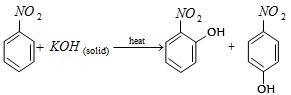
The following reaction is
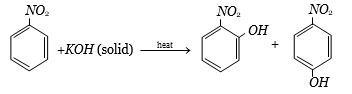
- ✓Nucleophilic substitution
- BElectrophilic substitution
- CFree radical substitution
- DNone of these
Generate a complete, print-ready paper with questions like this in minutes — across 16+ boards, with answer keys.
$C_2H_4(g) + H_2(g) \to C_2H_6(g)$
| Bond | Bond energy $(kJ)$ |
| $C-H$ | $413$ |
| $C-C$ | $348$ |
| $C=C$ | $610$ |
| $H-H$ | $436$ |
$(A)$ $CO _2, C _2 H _4, NO$ and $HCl$
$(B)$ $NO _2, O _3, HCl$ and $H _2 SO _4$
$(C)$ $BCl _3, NO , NO _2$ and $H _2 SO _4$
$(D)$ $CO _2, BCl _3, O _3$ and $C _2 H _4$
$A$. Hydrogen bonding exists when $\mathrm{H}$ is covalently bonded to the highly electro negative atom.
$B$. Intermolecular $\mathrm{H}$ bonding is present in o-nitro phenol
$C$. Intramolecular $\mathrm{H}$ bonding is present in $\mathrm{HF}$.
$D$. The magnitude of $\mathrm{H}$ bonding depends on the physical state of the compound.
$E$. H-bonding has powerful effect on the structure and properties of compounds.
Choose the correct answer from the options given below :